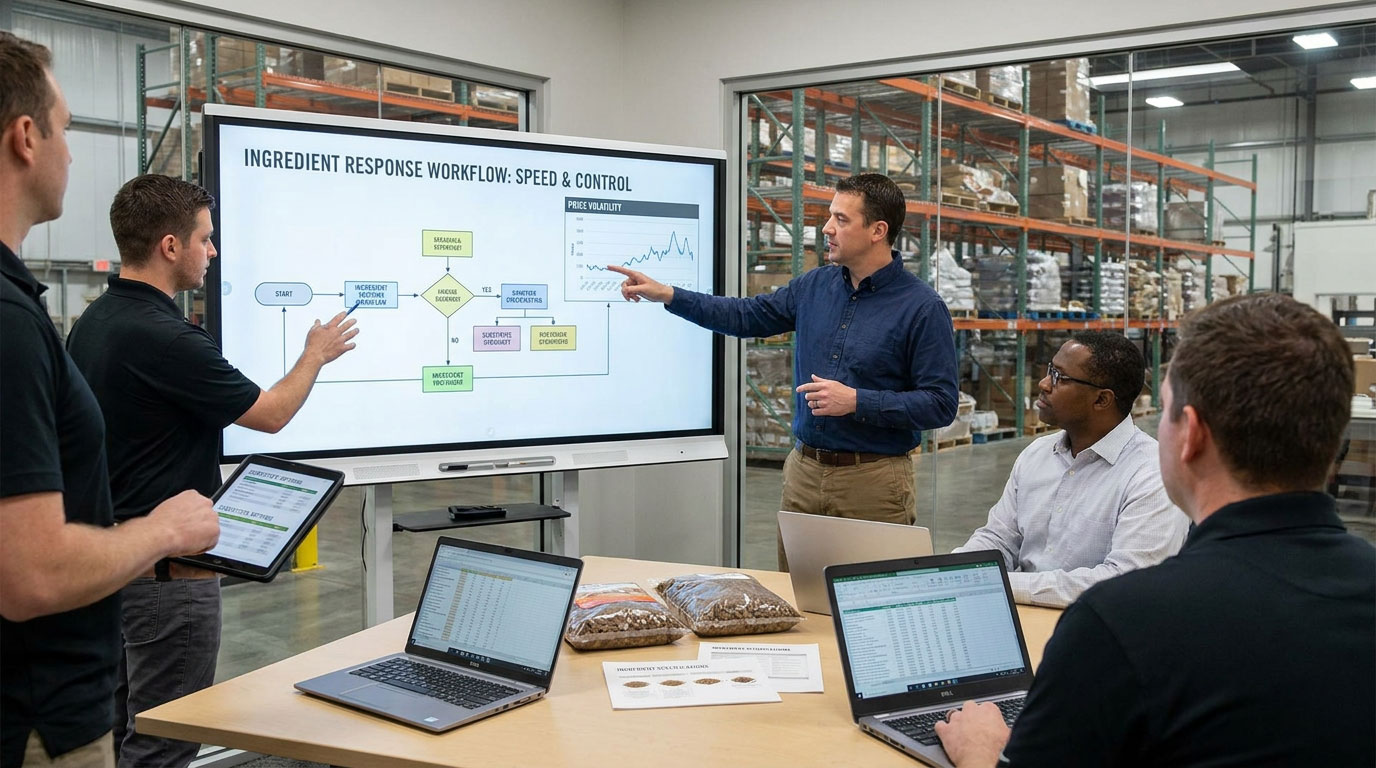


One ingredient change can create decisions across an entire pet food business. Procurement needs a sourcing alternative. Formulators need to understand nutritional consequences. R&D wants to anticipate product performance. Quality and regulatory teams need the rationale, the right specifications and a controlled approval process.
The immediate question may be what can replace the ingredient. Choosing the right alternative also requires understanding its consequences for the formula, the product and the business.
Ingredient cost remains essential. A useful decision brings together the available options, the evidence behind them and the requirements that every candidate must meet. That is the opportunity for more intelligent formulation.
A lowest-cost result starts a wider decision
Least-cost optimization has a clear purpose: identify an ingredient combination that minimizes cost while satisfying defined constraints. Its usefulness depends on the accuracy of the ingredient data, the constraints and the question being asked.
A technically acceptable solution still leaves commercial and scientific decisions. Is the substitute available at the required volume? How confident are we in its composition? What additional evaluation is needed? Does the change affect other products?
Established formulation platforms already offer capabilities such as scenarios, multi-formula optimization and version control.[2] Enterprise buyers should examine how a workflow connects alternatives, proprietary knowledge and approvals, and how clearly the team can explain the resulting decision.
Make the trade-offs explicit
Multi-objective decision-making starts by distinguishing requirements from preferences. Nutritional specifications, ingredient restrictions and approved inclusion limits may be hard constraints. Cost, selected environmental measures and predicted product attributes can then inform the comparison among alternatives.
Teams must decide which objectives to prioritize and how rankings will be interpreted. A slightly more expensive option could be worth examining if it reduces dependence on a constrained ingredient. Another may offer an attractive modeled performance profile but require more validation.
Environmental comparisons need consistent underlying data and clearly defined boundaries. A useful comparison makes these trade-offs visible and gives experts the information needed to judge them.
Follow an ingredient change through the business
Consider an illustrative scenario: a manufacturer needs to replace a constrained protein ingredient in an adult dog-food recipe. This is a planning example, not a customer case study.
First, the formulation team holds the nutritional and product requirements constant while screening substitute combinations. Procurement contributes current prices, availability and supplier information. The team compares the resulting options and their total formulation costs.
Next comes scenario analysis. What happens if the preferred substitute becomes more expensive? Which constraint is driving cost? Would a different approved inclusion limit materially change the options? These questions can inform sourcing discussions before a formula is released.
If the company has a validated predictive model, it can estimate selected performance attributes to prioritize candidates for further evaluation. Predictions remain conditional on the model's training data and applicability.
Finally, examine the portfolio. Which products and variants use the affected ingredient? Which specifications, labels, trials or approvals need review? A local recipe adjustment can then move through a controlled enterprise change process.
Give optimization, prediction and AI assistance distinct jobs
Mathematical optimization searches for solutions against supplied objectives and constraints. The result depends on whether those inputs represent the real formulation problem.
Predictive models estimate an outcome from available evidence. A palatability or digestibility prediction is an estimate whose usefulness depends on validation, uncertainty and the relevance of the underlying data.
AI assistance helps people express questions, navigate information and examine alternatives. Its responses need appropriate sources, access controls and expert review. FormuLogic combines conversational assistance with constrained optimization and supports connected proprietary models.[1,6]
The formulator interprets the result. Procurement understands sourcing conditions; quality and regulatory specialists assess their requirements; R&D determines the necessary evaluation. Laboratory work, production validation and other testing appropriate to the product and claim remain part of development.
Preserve the decision behind the recipe
A formula record should show what changed, which data and assumptions were used, which alternatives were considered, who approved the decision and which version is authorized for use. Version history, comparisons and approval records make that decision easier to reconstruct as a formula moves between teams.
Nutritional adequacy also has a defined evidentiary context. FDA describes AAFCO nutrient profiles and feeding trials as routes to supporting a complete-and-balanced claim. FEDIAF publishes science-based guidance for formulating and assessing pet foods in Europe.[4,5] A software result alone does not establish every finished-product or labeling requirement.
Proprietary information deserves equal attention. Buyers should establish who can access formulas and models, how information is isolated and what use of that information for AI training is permitted.
Bring the workflow together with FormuLogic
FormuLogic from Cambridge PetTech brings multi-objective optimization, ingredient substitution, scenario analysis and product-lifecycle workflows into one platform. Teams can explore up to 50 ranked solutions and select candidates for deeper comparison. Available alternatives depend on the formulation problem and configured constraints.
Natural-language assistance helps teams explore the brief, while connected proprietary models add company-specific predictions. Version history, configurable approvals and product-family connections help teams follow the consequences of a change. Customer formulations, ingredient data and models remain isolated, with no shared training or cross-customer reuse.[1]
Bring a real decision to the demonstration
Start with an ingredient constraint, an upcoming reformulation or a portfolio change. Compare alternatives using your requirements, examine the assumptions and predictions, and follow the selected option through review.
Measure a pilot against your current process: time spent evaluating alternatives, review cycles, traceability and the quality of the final decision. This gives the business case a practical foundation.
Formulate smarter. Adapt faster. Optimize with confidence.
Explore FormuLogic and schedule a demonstration around a formulation decision your team needs to make.
https://www.cambridgepettech.com/formulogic
Sources
1 Cambridge PetTech FormuLogic product page
https://www.cambridgepettech.com/formulogic
2 Datacor formulation capabilities
https://www.datacor.com/products/formulation/capabilities
3 FDA Complete and Balanced Pet Food
https://www.fda.gov/animal-veterinary/animal-health-literacy/complete-and-balanced-pet-food
4 FEDIAF Nutritional Guidelines
https://europeanpetfood.org/self-regulation/nutritional-guidelines/
5 Cambridge PetTech AI formulation explanation
https://www.cambridgepettech.com/blogs/ai-powered-pet-food-formulation