

The business problem: Two risk surfaces, one platform decision
When an enterprise evaluates pet food formulation software, two distinct risk conversations happen. Both these conversation often happen with different stakeholders, and at different stages of the evaluation. Either one can derail the decision.
The IP risk conversation: Recipes are trade secrets. A formulation database concentrates decades of competitive advantage in one system, so the CIO's questions are existential. He must have answers to: Where does the data live? Who can access it? Is it used to train models that benefit anyone else? In an era of AI-powered tools, that last question has become critical to formulation software security. Many vendors improve shared models with customer data. For proprietary formulation IP, that is simply unacceptable.
The regulatory risk conversation: Pet food formulation operates against AAFCO nutrient profiles, therapeutic specifications, and label commitments like guaranteed analysis. When regulators or auditors ask why a formulation changed, "we believe it was reviewed" is not an answer. Quality leaders need clear, auditable evidence: who changed what, when, against which spec, and who approved it. Spreadsheet-era workflows cannot produce that proof without archaeology. Files, emails, and approval records often need to be reconstructed manually before a regulatory review can even begin.
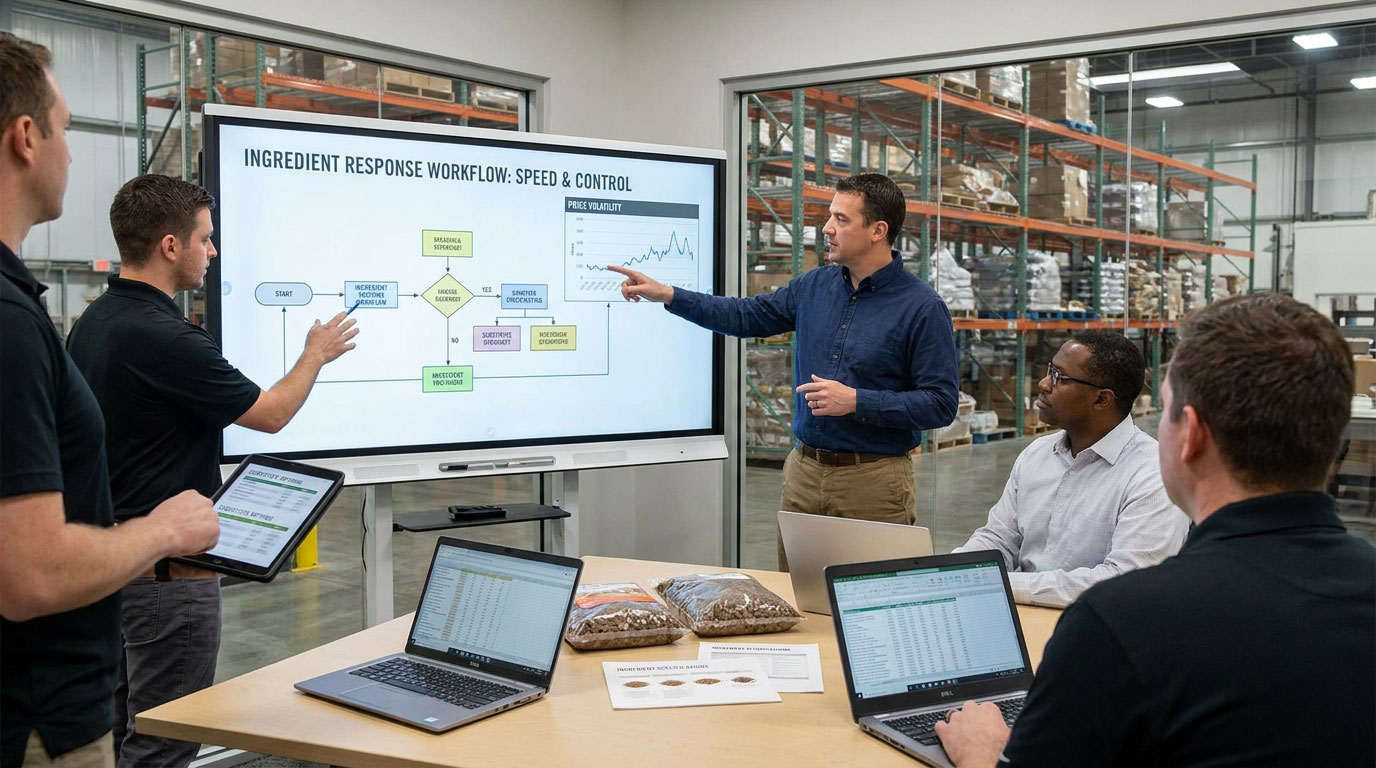
Most tools force a trade-off: agile but ungoverned, or governed but slow. Enterprises need both speed and control within the same formulation workflow.
The solution: Security, control, and traceability as platform architecture
FormuLogic addresses our formulations platform, addresses both risk surfaces structurally. Security, compliance, and formulation governance are built into the architecture rather than added after deployment.
Data and model isolation
Your formulations, ingredient data, and models remain fully isolated with no shared training, no reuse across customers, and no external exposure. This design commitment helps address the central IP concern: your formulation intelligence compounds for you alone.
Enterprise security controls
SOC 2 Type II controls, single sign-on with SSO/SCIM provisioning, role-based access control, and full audit logging across all actions. Identity and access connect to your existing enterprise stack rather than creating a parallel credential surface. This gives IT teams centralized control over who can access sensitive formulation data.
Deployment flexibility
Choose SaaS, dedicated VPC, or on-premise deployment, aligned with your security, compliance, data-residency, and data-governance policies. Organizations with strict data-residency or air-gap requirements can select a deployment model that reflects those requirements.
Granular workflow control
Define who can view, edit, approve, and deploy formulations across teams, regions, and workflows without compromising speed. A junior formulator can generate scenarios, but only designated approvers can sign off. Only authorized roles can push approved formulations to PLM or ERP systems.
Compliance by construction
AAFCO profiles with custom min/max targets, urine pH, ME, and brand-specific therapeutic specs are applied to every candidate and every revision. This makes compliance part of the formulation workflow rather than a downstream checkpoint.
End-to-end traceability
Full version history with differences, configurable approval workflows with electronic sign-off, and a complete formulation audit trail of every formulation change, decision, and approval. The complete record can be retrieved when needed during a quality audit or regulatory review.
Cambridge PetTech itself operates under ISO 27001:2022, ISO 20000-1:2018, and SOC 2 Type II certifications, backed by 25+ years of enterprise delivery for global organizations.
Key capabilities (governance view)
● SOC 2 Type II controls; SSO/SCIM; RBAC; and full audit logging
● SaaS / dedicated VPC or on-premise deployment options
● Complete data and model isolation with no shared training
● Version history with diffs and rollback for traceable formulation changes
● Configurable approval workflows with electronic sign-off
● Custom spec enforcement including AAFCO, urine pH, ME, and therapeutic requirements on every scenario
● Export and handoff to PLM/ERP systems, with access controls intact
Business value
For the CIO and CTO, FormuLogic consolidates ungoverned shadow tooling (spreadsheets on shared drives, local solver files) into a governed system of record. This can reduce the security exposure and IP leakage risks associated with fragmented formulation tools while supporting security review with recognized certifications. For quality and compliance leaders, audit response moves from a multi-week document hunt into a query against a formulation audit trail. This can simplify regulatory reporting and make formulation decisions easier to verify. For the business, faster formulation governance at machine speed removes the classic trade-off. Approval workflows are configurable to your real sign-off chain, so control adds accountability without adding cycle time. For Total Cost of Ownership (TCO), FormuLogic replaces the hidden costs of maintaining, reconciling, and securing fragmented tools.
Enterprise use cases
● Regulatory review readiness: Produce the complete change-and-approval history for any SKU's formulation on demand.
● Multi-region governance: Apply region-appropriate specs and region-scoped access controls within one platform.
● M&A and audit diligence: Demonstrate formulation IP custody and decision provenance with system evidence rather than attestations.
● Contract manufacturing oversight: Grant co-manufacturers precisely scoped view/edit rights without exposing the wider portfolio.
An illustrative customer scenario
A composite example: A multi-brand manufacturer faces a regulatory inquiry about a therapeutic diet's formulation history across three revisions. Under its previous workflow, assembling the response would mean reconstructing spreadsheet versions, email approvals, and a retired formulator's notes.
On FormuLogic, the quality director pulls the complete formulation audit trail. It includes every change with diffs, the spec each revision was validated against (including urine pH and ME targets), and the electronic sign-offs with timestamps. The quality team submits a defensible, system-generated record within days. The inquiry closes without findings, and the board hears about it. What was once a document-reconstruction exercise becomes a traceable regulatory response.
Implementation overview
Governance configuration is a first-class implementation stream in FormuLogic, not an afterthought:
(1) Conduct the security review and deployment-model selection (SaaS, VPC, or on-premise) with your IT and data-governance teams;
(2) SSO/SCIM integration and role design mapped to your actual org structure, and access-control policies.
(3) Configure approval-workflows to mirror your quality management system's sign-off chain.
(4) Encode nutritional, therapeutic, and brand specifications with clear quality and regulatory ownership
(5) Validate the formulation audit trail as part of user acceptance testing. Teams should confirm that changes, specifications, approvals, and sign-offs can be retrieved in the format required for review.
Best practices
Bring IT security into the evaluation early. Questions about deployment, data residency, identity management, and formulation data isolation are easier to resolve at the start of the process. Map roles to your quality manual, not to convenience. The access should reflect real responsibilities across formulation, quality, regulatory, procurement, and IT teams. Encode therapeutic and brand specs under formal change control. This helps keep compliance-by-construction trustworthy as standards and product requirements evolve. Additionally, rehearse an audit: run a mock regulatory pull of a formulation history during UAT, so the first real request is routine.
If your formulation IP and compliance evidence live in spreadsheets today, it may be time to assess the gaps in your current formulation governance process. Schedule a security-and-governance-focused demo at sales@cambridgepettech.com, and bring your CISO.
FAQs
Is customer formulation data used to train shared models in FormuLogic?
No. Formulations, ingredient data, and models remain fully isolated across FormuLogic, with no shared training, cross-customer reuse, and external exposure. This helps protect proprietary formulation data and customer-specific optimization models.
What deployment options exist for strict data-governance policies across FormuLogic?
SaaS, dedicated VPC, or on-premise, selected to align with your security, compliance, data-residency, and data-governance requirements. The available options allow organizations to choose an architecture suited to their internal IT policies.
What security controls does FormuLogic provide?
FormuLogic provides SOC 2 Type II controls, SSO/SCIM, role-based access control, and full audit logging across all actions. These controls support identity management, access governance, and traceability across formulation workflows.
How does FormuLogic support regulatory review?
Every formulation change, decision, and approval is tracked in a complete formulation audit trail with version diffs and electronic sign-offs. The record can be retrieved when needed during a quality audit or regulatory review.
What certifications does Cambridge PetTech hold?
Cambridge PetTech operates under ISO 27001:2022, ISO 20000-1:2018, and SOC 2 Type II certifications.