

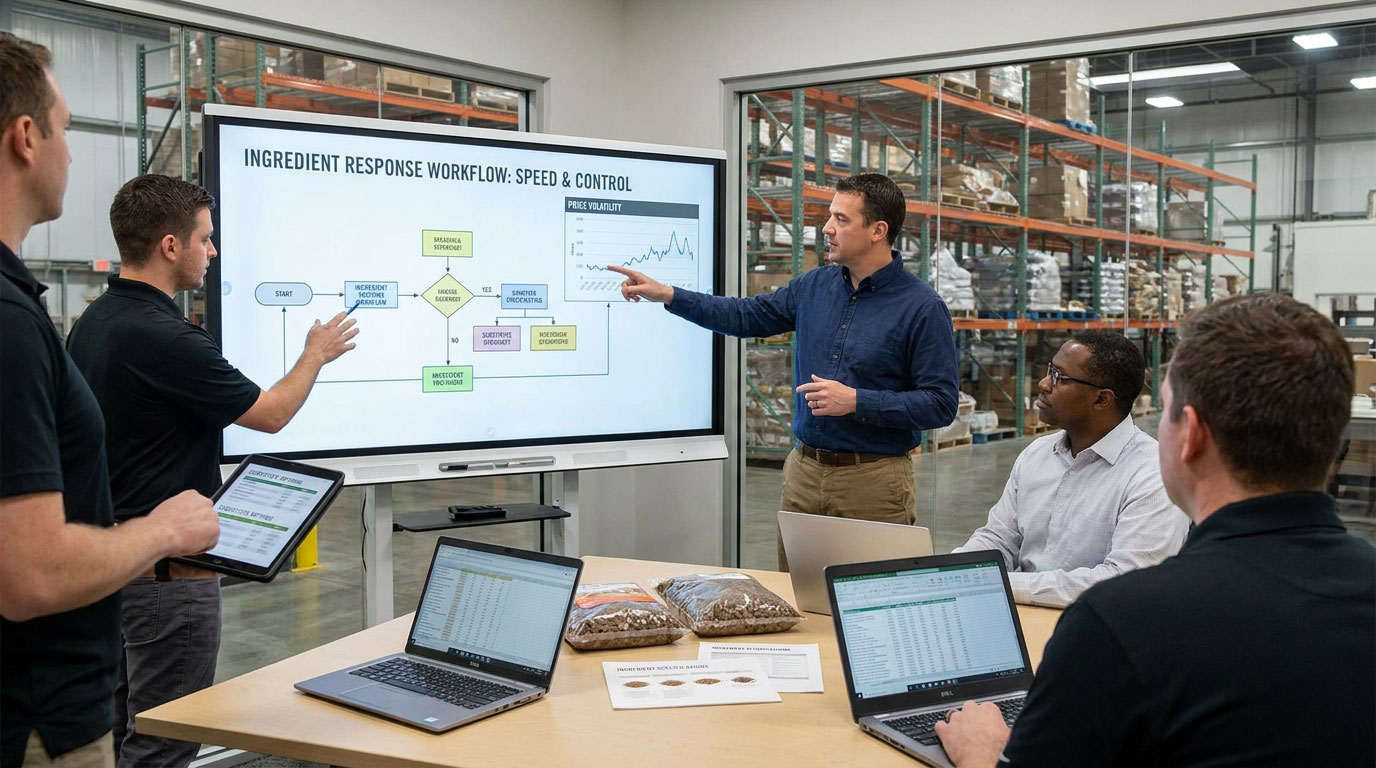
Ingredient substitution in pet food often begins when something changes without warning. A supplier may reduce availability. A key input may become more expensive. A regional sourcing constraint may affect production plans. A specialty ingredient may become harder to secure at the right quality or price.
For pet food manufacturers, the immediate pressure is commercial and operational. Procurement teams need sourcing options quickly. R&D and nutrition teams need to know whether a substitute can protect the formula. Regulatory, packaging, and commercial teams need to understand what the change affects downstream.
A fast response cannot be based on a simple swap. A single ingredient change can affect nutrient balance, palatability, digestibility, processing behavior, claims, label copy, packaging, cost, margin, and product family consistency.
That is why sudden price or supply changes require a structured reformulation response. Teams need a way to compare viable substitutes, understand trade-offs, evaluate downstream implications, and document why a specific pathway was selected.
This blog explains why ingredient volatility creates formulation risk, what a strong response workflow should include, and how pet food manufacturers can respond to cost and supply pressure with speed, control, and confidence.
Why sudden ingredient changes create formulation risk
Ingredient volatility is not new for pet food manufacturers. The challenge is that the impact of a price or supply shift rarely stays within procurement.
If an ingredient becomes expensive, unavailable, inconsistent, or commercially unattractive, the substitute needs to be evaluated across nutrition, formulation constraints, palatability, processing, sourcing continuity, claims, labels, and business goals. The risk is that teams move quickly, but not completely.
A substitute protein may protect margin while changing amino acid balance or palatability. A new fiber source may improve availability but introduce digestibility or processing questions. The substitute may look viable in a spreadsheet, yet create complications once the full product, compliance, and commercial context is reviewed.
This is where ingredient substitution becomes a cross-functional business decision. R&D may own formula feasibility, but the outcome affects procurement, regulatory, packaging, operations, commercial teams, and customer trust.
What a faster ingredient response workflow should include
A strong response workflow gives teams a structured way to act when ingredients become expensive, unavailable, or difficult to use. It defines how alternatives will be evaluated, what trade-offs matter, who needs to review the decision, and how the final pathway will be documented.
The purpose is not to slow the response. It is to prevent rushed reformulation decisions from creating avoidable issues later in the launch, production, compliance, or commercial process.
A structured response gives teams a clear set of questions to answer before committing to a reformulation pathway:
Why one-for-one substitution is rarely enough
Ingredient substitution can look simple from a sourcing perspective. In formulation practice, a one-for-one replacement rarely captures the full impact of the change.
A substitute ingredient can shift nutrient profile, ingredient order, processing behavior, palatability assumptions, label copy, claim support, and product family consistency. The strongest option is not always the lowest-cost option. It is the pathway that gives teams the best balance of cost, nutrition, performance, feasibility, and downstream readiness.
That balance is difficult to judge when teams evaluate substitutes in isolation. Scenario comparison gives teams a clearer way to understand the trade-offs before committing to a reformulation pathway.
How procurement and R&D can respond from the same assumptions
Sudden ingredient changes often expose a collaboration gap. Procurement may be focused on price, supplier capacity, availability, and sourcing continuity. R&D is focused on nutrient balance, ingredient function, product performance, palatability, and processing behavior.
Regulatory and packaging teams add another layer because a formulation change can affect ingredient statements, claims, nutritional adequacy language, artwork, and market requirements. Commercial teams need visibility into margin, price positioning, launch timing, and retailer impact.
A shared formulation workflow helps teams evaluate the same problem from different functional lenses. Instead of debating which file or assumption is current, teams can align around the constraints and trade-offs that shape the final decision.
From emergency substitution to governed reformulation
When price or supply changes appear overnight, teams can move into emergency mode. Speed becomes the priority, and governance may become scattered across supplier notes, formulation files, spreadsheets, approval comments, and email threads.
A governed reformulation workflow gives teams a way to move quickly while preserving decision quality. It keeps the original ingredient risk, substitute options, assumptions, trade-offs, downstream implications, approvers, and final pathway connected.
For decision makers, this matters because the response needs to be reusable. If the same volatility pattern appears again across another product line or region, teams should not have to rebuild the decision from memory.
What decision makers should expect from a volatility response workflow
A response workflow should support more than technical substitution. It should help leaders see whether the organization can act quickly without compromising quality, margin, launch readiness, or accountability.
For enterprise teams, the workflow should make reformulation decisions easier to compare, easier to approve, and easier to explain.
Practical checklist: Is your reformulation workflow ready for overnight disruption?
Supporting faster response to ingredient price and supply changes
As pet food and animal feed teams look to respond faster to ingredient volatility, connected formulation workflows can help bring ingredient data, scenario modeling, nutritional specifications, cost assumptions, substitute options, and downstream review into the same decision process.
Cambridge PetTech’s FormuLogic is designed to support this kind of workflow by helping teams model ingredient constraints, compare substitution scenarios, evaluate trade-offs, and preserve the reasoning behind formulation decisions. For teams managing complex portfolios and fast-moving supply conditions, the value lies in making reformulation decisions faster, clearer, and easier to govern.
Learn more about the FormuLogic
Conclusion
Ingredient substitution in pet food is no longer a narrow cost-control task. When prices or supply conditions change quickly, the impact can extend across nutrition, palatability, processing, claims, packaging, sourcing, product family consistency, and commercial performance.
Pet food manufacturers need a governed way to compare options and choose a reformulation pathway with confidence. The teams that build this capability are better prepared to protect product quality, reduce rework, maintain launch readiness, and respond to volatility with greater control.
The advantage is not simply having a substitute available. It is knowing which pathway is technically, commercially, and operationally defensible before pressure forces the decision.
FAQs
What is ingredient substitution in pet food?
Ingredient substitution in pet food is the process of replacing one ingredient with another while preserving nutritional adequacy, product performance, palatability, cost targets, claims, regulatory confidence, and product quality.
Why do pet food manufacturers need a structured response to ingredient price changes?
A price change can affect more than formula cost. It can influence nutrient balance, claims, labels, processing, margins, supplier decisions, and product family consistency.
How do pet food teams respond when ingredient supply changes suddenly?
Teams respond by identifying at-risk ingredients, shortlisting viable substitutes, modeling nutrition and cost impact, reviewing downstream claims and labels, and documenting the selected reformulation pathway.
Why is one-for-one ingredient substitution risky?
One-for-one substitution can overlook changes in nutrient profile, palatability, digestibility, processing behavior, claim support, ingredient order, and packaging or PDP content.
Which teams should be involved in ingredient substitution decisions?
R&D, nutrition, procurement, regulatory, packaging, quality, commercial, and product teams should be involved because ingredient changes can affect both technical and business outcomes.
What does Cambridge PetTech’s FormuLogic help teams do?
Cambridge PetTech’s FormuLogic helps teams model ingredient constraints, compare substitution scenarios, evaluate trade-offs, and document formulation decisions across cross-functional workflows.