


A supplier raises chicken meal prices by 20%. Several products use that material, but their cost exposure differs. R&D needs to identify which recipes warrant reformulation, which can remain unchanged, and where better purchasing terms could protect margin without a development project.
Start by calculating the increase across affected products. Then compare feasible responses over the same production period. FormuLogic's What-If analysis helps connect ingredient-price changes to formulation choices; reviewing those scenarios across the portfolio gives procurement and finance a common basis for discussion with formulators.
How much does the increase cost across the portfolio?
For unchanged recipes, multiply each product's baseline ingredient cost by chicken meal's share of that cost and the percentage price increase. Then multiply the additional cost per lb by the exposed production volume.
Use cost share, not inclusion percentage. If chicken meal represents 30% of ingredient cost, a 20% price increase raises total ingredient cost by 6%, assuming other prices and yield remain unchanged.
Worked example: three affected products. These hypothetical figures illustrate the calculation; they are not market prices, customer data, or FormuLogic outputs. All volume is assumed exposed for a full year.
Hypothetical annual portfolio exposure
The combined exposure is $152,000. That identifies the scale of the problem, not the savings available from reformulation. Adjust for inventory, contract coverage, and purchase dates before budgeting. Count finished-product volume once where several pack sizes share a recipe.
Product A has the largest exposure, but another product may offer an easier substitution. Review technical opportunity alongside dollars at risk when assigning R&D effort.
Keep the portfolio view traceable to each recipe version and its production plan. Products sharing an ingredient do not necessarily share nutrient specifications, permitted substitutes, or customer commitments. Apply the same price scenario to affected formulations, then review their individual responses before totaling the financial impact.
Does the current formulation still make sense?
Use price sensitivity to assess the current solution, then evaluate alternatives under the revised assumptions. A more expensive ingredient does not necessarily make a different recipe preferable.
FormuLogic's Range of Optimality analysis helps investigate ingredient-price sensitivity. Within an applicable range, the selected solution may remain optimal while its cost rises. Crossing that range does not establish that reformulation will recover its implementation cost.
Classical linear-programming ranges describe objective-coefficient changes that preserve an optimal basis. They are conditional results, not forecasts. Rerun scenarios when several inputs change; nonlinear, discrete, or multi-objective models require analysis appropriate to their configuration. [1]
What does Shadow Cost Analysis add?
It helps identify which constraints drive formulation cost. FormuLogic's What-If scenario capability includes Shadow Cost Analysis, allowing formulators to investigate the economics of a requirement rather than focusing only on ingredient prices.
A minimum inclusion requirement, for example, may restrict substitution. A shadow cost estimates the local cost effect of changing a constraint bound under the applicable model assumptions. Interpret its sign, units, and valid range; it is not automatically a supplier discount. [2]
A costly constraint may still be mandatory. Nutrient limits and explicit palatability requirements remain in force unless an authorized revision is justified. Palatability comparisons must retain their specified control and response threshold.
For R&D, the useful output is a focused investigation: which requirement prevents a lower-cost formulation, and is there evidence supporting a different specification? Rebalance the complete recipe when evaluating a substitution. Savings on chicken meal can be offset by compensating changes elsewhere in the formula.
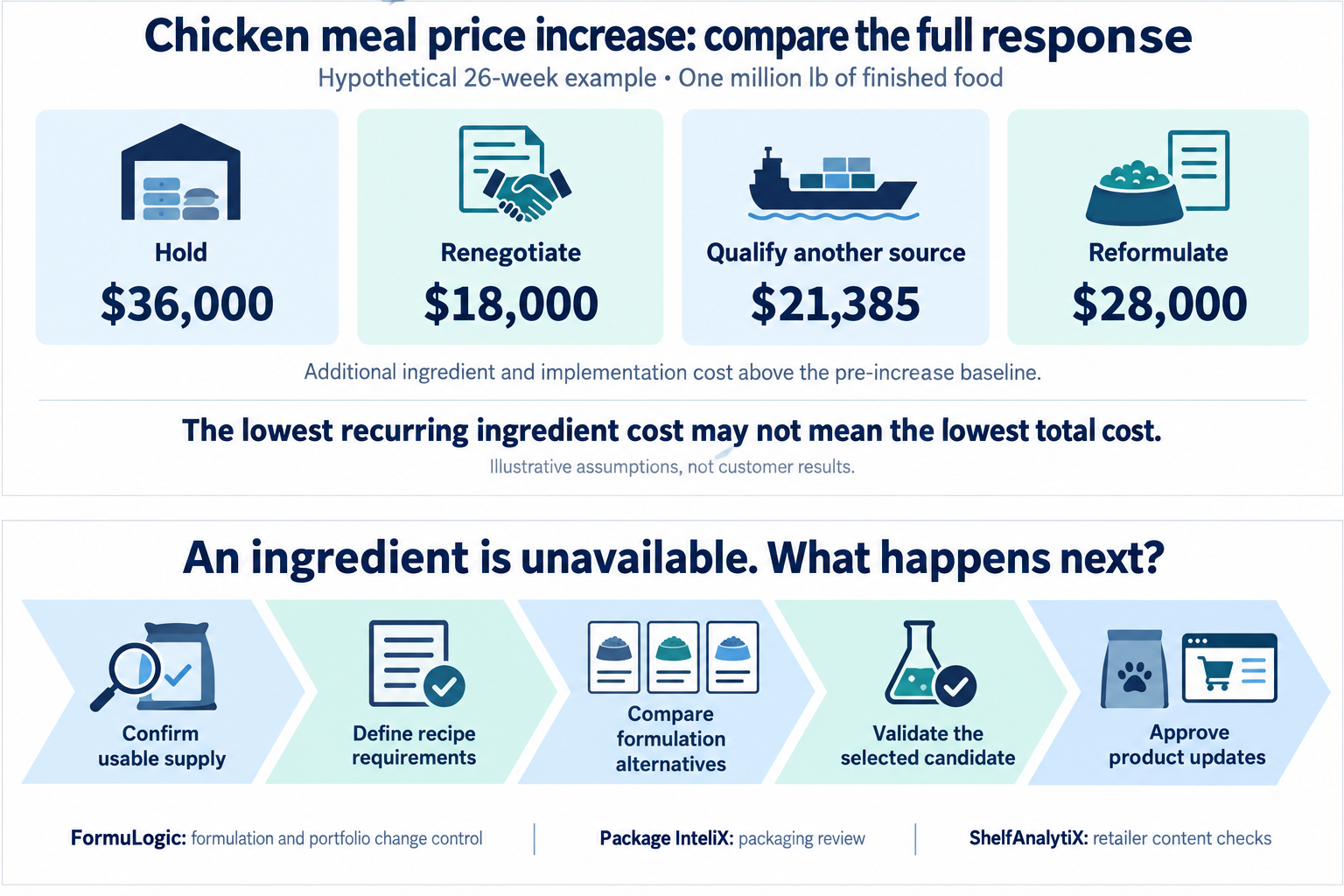
Should the team hold, renegotiate, re-source, or reformulate?
Compare total cost over the same horizon, including delays and implementation work. The lowest recurring ingredient cost may not produce the lowest near-term expenditure.
Continue the hypothetical example for Product A over 26 weeks: one million lb at a constant production rate. Its pre-increase ingredient-cost baseline is $600,000. The full increase raises cost to $0.636/lb. Assume that price applies until each alternative starts.
Hypothetical 26-week responses for Product A
Above the $600,000 baseline, including the stated one-time costs; totals rounded to the nearest dollar. Prices persist throughout the period. Yield and conversion costs are unchanged, routine administration is assumed equal, and financing and revenue effects are excluded.
Reformulation has the lowest recurring ingredient cost, yet immediate negotiation costs least over 26 weeks. Reformulation saves $8,000 against holding but costs $10,000 more than negotiation. Evaluate combined responses separately where purchasing commitments permit them.
How long must the saving last?
Count savings from implementation against the best achievable reference option. For Product A, reformulation saves $0.026/lb against holding. At the assumed rate, that is $1,000 per week.
The $12,000 project needs 12 weeks of savings after implementation, or 18 weeks from the decision with the six-week delay. Against negotiation, the saving is only $0.008/lb, so the case is substantially weaker.
If the price premium ends after 12 weeks, only six weeks remain after implementation: $6,000 of savings against holding, insufficient to recover the project cost during that window. Recalculate both recipes at subsequent prices before extending the forecast. Price duration and exposed volume belong in every scenario.
Run a shorter price shock, a sustained increase, and a lower-volume case. A reformulation that pays back only under the most favorable assumptions may still deserve prototype work, but the approval should state that dependency. Preserve both the original and revised assumptions so the decision can be revisited.
What else must a reformulation budget include?
Include the work needed to qualify, validate, and release the revised product. Confirm supply and processing performance, assess nutritional and predicted-performance changes, and identify customer approvals. A promising custom-model prediction does not complete product validation.
Ingredient changes may require label review: FDA describes ingredient listing by common or usual name in descending order by weight. [3] Package InteliX supports reviewing ingredient statements, claims, and artwork against approved inputs.
Where product information changes online, ShelfAnalytiX supports checking retailer listings and packaging images against approved product information. Budget those updates where relevant, allocating shared development costs without losing product-specific release costs.
How should R&D lead the response?
Bring technically viable alternatives and their implementation requirements to the commercial decision. Procurement supplies executable terms; finance checks exposure and payback. Formulators determine which alternatives merit development while protecting the product brief.
FormuLogic connects What-If analysis, constraint economics, and multiple formulation solutions. Across affected products, use these outputs to prioritize investigation, compare responses, and document why a recipe should change—or remain unchanged.
This gives procurement and finance useful formulation evidence without shifting technical ownership away from R&D. The same analysis can support negotiation today and a qualified contingency recipe for a later supply disruption.
Our related article on responding to ingredient price and supply changes covers the broader workflow. Before committing development effort, establish the alternative being compared, its start date, and the production volume available to recover the change cost.
Sources
- Gurobi Optimization. Variable Attributes: SAObjLow and SAObjUp. Technical definitions of objective-coefficient sensitivity ranges.
- Gurobi Optimization. Linear Constraint Attributes: Pi. Dual values, shadow prices, and model applicability. These references explain optimization concepts; they do not identify FormuLogic's solver implementation.
- US Food and Drug Administration. Animal Food Labeling and Pet Food Claims. Federal ingredient-labeling requirements.