

The business problem: The graveyard of R&D tools is full of good software
Every R&D leader has seen it. A capable tool purchased with enthusiasm, piloted by two people, and quietly abandoned within eighteen months. The failure pattern remains consistent. The tool didn't connect to the systems where cost data and product records actually live, so users maintained parallel spreadsheets anyway. Rollout targeted only formulators, so procurement and quality never adopted the shared workflow on which the value case depended upon. IT was engaged late, so security review stalled momentum. And nobody defined baseline metrics, so when budget season came, the tool had no measurable formulation platform ROI story to defend itself.
For a formulation platform, which touches R&D, procurement, quality, regulatory, and IT simultaneously, avoiding this pattern requires treating adoption as a designed program. Enterprise formulation software implementation must account for people, data, systems, governance, and measurable outcomes from the start.
The solution: A platform built to fit the enterprise it enters
Three design choices make FormuLogic, our formulation platform enterprise-deployable rather than merely enterprise-priced.
It connects to your systems of record
Connectors for SAP, Oracle, and NetSuite keep ingredient cost data current and allow approved formulation outputs to flow downstream. Integration with major PLM systems and lab-notebook handoff means FormuLogic augments your product-record architecture instead of competing with it. Every decision is exportable, explainable, auditable, and portable across the systems your teams already trust. This reduces duplicate data entry and helps prevent formulation teams from maintaining parallel records outside the enterprise workflow.
It serves three functions natively
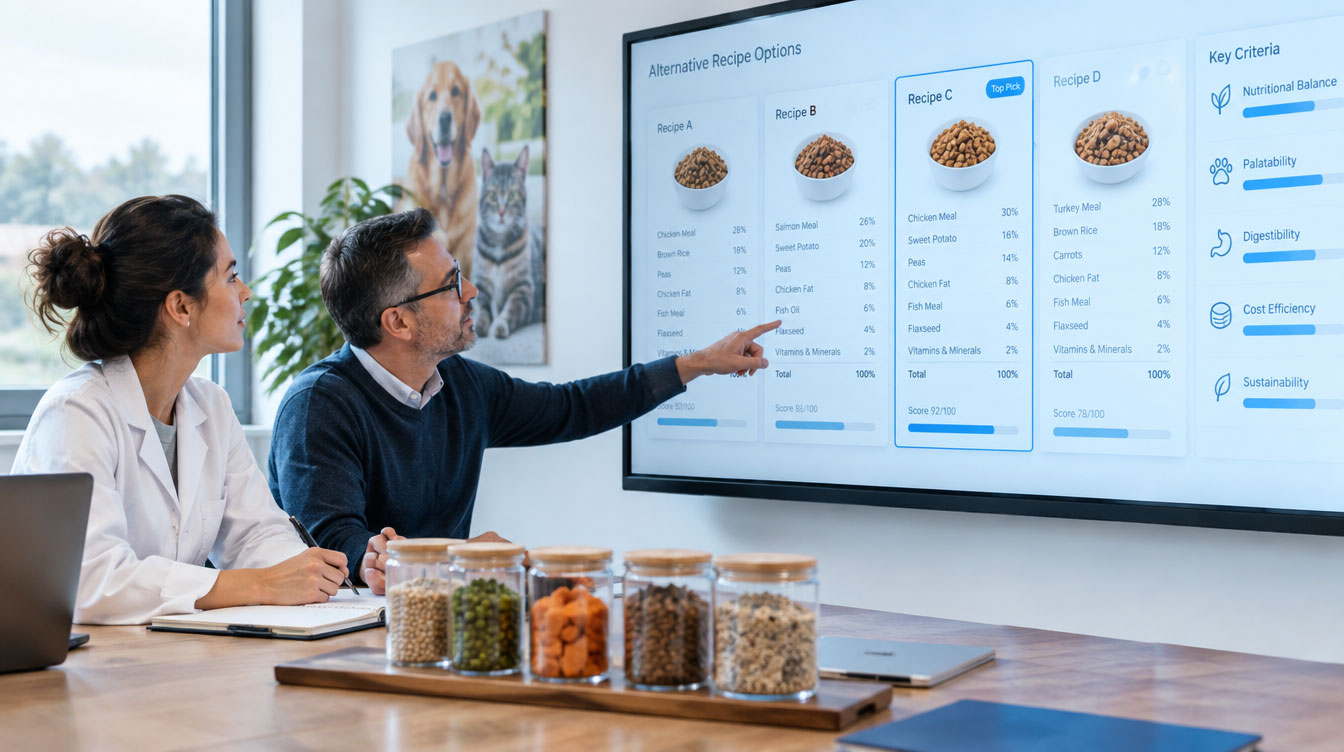
R&D and formulation teams, procurement teams, and quality/regulatory teams each get purpose-built views and controls over one shared source of truth. Adoption doesn't depend on forcing procurement into a formulator's interface. Each function sees its own value in its own terms. R&D can focus on formulation and scenario comparison. Procurement can assess cost and substitution impact. Quality and regulatory teams can review compliance and approval records.
It deploys on your terms
SaaS for speed, dedicated VPC for isolation, on-premise for the strictest data-governance policies with SOC 2 Type II controls, SSO/SCIM, and role-based access in every model. IT teams get to select an enterprise formulation software architecture that is aligned with their internal security, compliance, and data-residency requirements.
Key capabilities (Adoption overview)
● ERP connectors: SAP, Oracle, and NetSuite supporting live cost inputs, downstream handoff
● Formulation software integration with PLM integration and lab-notebook export
● Role-based views for R&D, procurement, quality and regulatory teams
● SSO/SCIM provisioning through your identity provider
● Configurable approval workflows matched to your quality management system
● Deployment options: SaaS, dedicated VPC, or on-premise
● Complete audit trail supporting parallel-run validation and formulation governance
A phased rollout blueprint
Phase 0 — Baseline (before contract signature)
Measure current state: average reformulation cycle time, trials per launch SKU, and time from brief to shelf. These become your ROI denominators. Without this formulation performance baseline, later improvements are difficult to quantify or defend.
Phase 1 — Foundation (data and identity)
Load the ingredient database (composition, cost, sustainability attributes); encode nutritional standards including AAFCO baselines and custom/therapeutic specs; integrate SSO/SCIM and design roles; select deployment model with IT. This phase establishes the data, access, and governance foundation for FormuLogic's implementation.
Phase 2 — Pilot (one category, three functions)
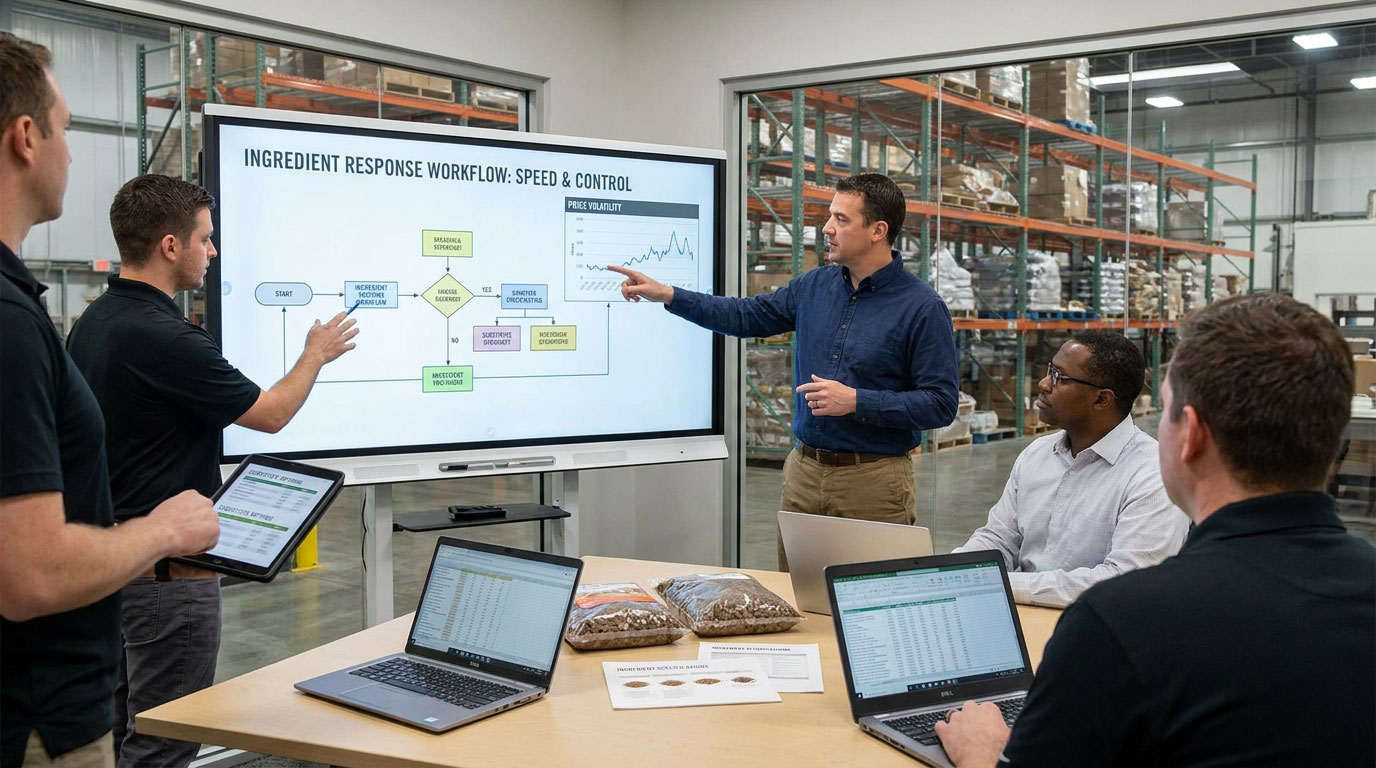
Choose a high-volatility category where speed value is visible. Run FormuLogic in parallel with the legacy process; validate outputs; include procurement and quality from day one, not as later-stage afterthoughts. A cross-functional formulation software pilot tests both technical performance and user adoption.
Phase 3 — Integration (systems of record)
Connect ERP for live cost data; configure PLM handoff; wire approval workflows to mirror your actual sign-off chain with electronic signatures. The purpose is to connect formulation work with existing enterprise systems rather than create another isolated workflow.
Phase 4 — Scale (portfolio and regions)
Extend category by category, applying region-appropriate specs and scoped access. Publish cycle-time and trial-cost metrics against Phase 0 baselines each quarter. Use the results from each rollout phase to guide adoption across additional brands, categories, plants, and regions.
Business value and the ROI model
Build the business case on four value streams, each mapped to one of FormuLogic's platform outcome.
R&D capacity: 70% faster formulation time is equivalent to expanding capacity without adding headcount. Value it at the loaded formulator cost against your Phase 0 cycle baseline.
Trial cost avoidance: 75% lower trial costs per launch SKU, multiplied by your annual launch count. This calculation should account for bench trials, ingredient use, laboratory work, and other avoidable development costs where data is available.
Revenue timing: 5x faster brief-to-shelf can bring launch revenue forward. Value even one quarter of acceleration per launch.
Margin protection: Faster reformulation in response to commodity price changes, shows up in COGS. Use your last price-shock event as the reference case.
Against these streams, weigh the full Total Cost of Ownership (TCO): subscription, integration effort, data preparation, and change management. The consolidation dividend, including retired solver licences, reduced spreadsheet maintenance, and less manual compliance checking, can offset part of that cost.
Enterprise use cases
● Global manufacturer: phased regional rollout with region-scoped specs, access controls, and a shared ingredient master.
● Multi-brand portfolio: brand-specific nutritional standards enforced per line within one governed platform.
● Co-manufacturing network: scoped partner access for collaborative formulation without portfolio exposure.
● Transformation program: formulation as the flagship AI use case in a broader digital-transformation roadmap, supported by Cambridge PetTech's AI Discovery Workshop.
An illustrative customer scenario
A composite example: A manufacturer with three plants and two ERP instances SAP and NetSuite, following an acquisition, pilots FormuLogic in its highest-volatility dry-food category. Phase 0 baselining shows a 6-week average reformulation cycle. The pilot runs in parallel with the legacy process for one quarter, with both ERP connectors live, validating cost inputs against finance's numbers. That is the step that gives the CFO confidence in the results. By scale-up, cycle time in the pilot category has fallen dramatically, trial counts per launch are down, and quality has retired its manual compliance checklist for that category. The Phase 0 baseline turns those results into a board-ready ROI narrative that funds portfolio-wide rollout. Because the organization measured the starting point, it can show where the value came from and use that evidence to support the next phase.
Best practices
Sign with a baseline, not just a contract. An unmeasured formulation software deployment cannot demonstrate its value when the budgets are reviewed. Sequence people before systems. Pilot with all three functions R&D, procurement, and quality, before expanding the integration footprint. Integrate ERP and PLM systems once the cross-functional workflow and requirements are clear.
Give IT the deployment-model decision early. Dedicated VPC and on-premise options exist to address stricter security, data-residency, and governance requirements before they delay the rollout. Mirror real approval chains in workflow configuration. Idealized workflows get bypassed. Publish wins quarterly; internal marketing is a part of the adoption.
Our formulation platform, FormuLogic, is a transformation program with software inside. Start it the right way. Book a Cambridge PetTech AI Discovery Workshop a tailored, expert-led session that produces a custom adoption plan or schedule a demo at sales@cambridgepettech.com with your IT and R&D leads in the same room.
FAQs
Which enterprise systems does FormuLogic integrate with?
Connectors are available for SAP, Oracle, and NetSuite, plus integration with major PLM systems and lab-notebook handoff. These formulation software integrations help keep ingredient costs current and move approved outputs into existing enterprise workflows.
What deployment models are supported in FormuLogic?
SaaS, dedicated VPC, or on-premise aligned with your security, compliance, and data-governance policies. The appropriate model depends on your organization’s architecture and internal control requirements.
How long should a pilot run?
Best practice is to run FormuLogic in parallel within one category for enough time to validate outputs against your legacy process and produce metric differences against a pre-agreed baseline. Depending on the category and formulation workload, this may take one to two quarters.
Who needs to be involved in rollout?
R&D and formulation, procurement, and quality and regulatory teams should participate as users. IT should support identity, integration, security, and deployment. Finance should help define the ROI baseline and validate the resulting business case.
How do we measure ROI for FormuLogic?
Measure ROI against four value streams: R&D capacity, based on 70% faster formulation; trial-cost avoidance, based on 75% lower trial costs per launch SKU; revenue timing, based on 5x faster brief-to-shelf; and margin protection during commodity volatility. Apply these outcomes to your own Phase 0 baselines and compare them with the full cost of implementation, integration, data preparation, and change management.