

The business problem: Five challenges delaying the formulation process
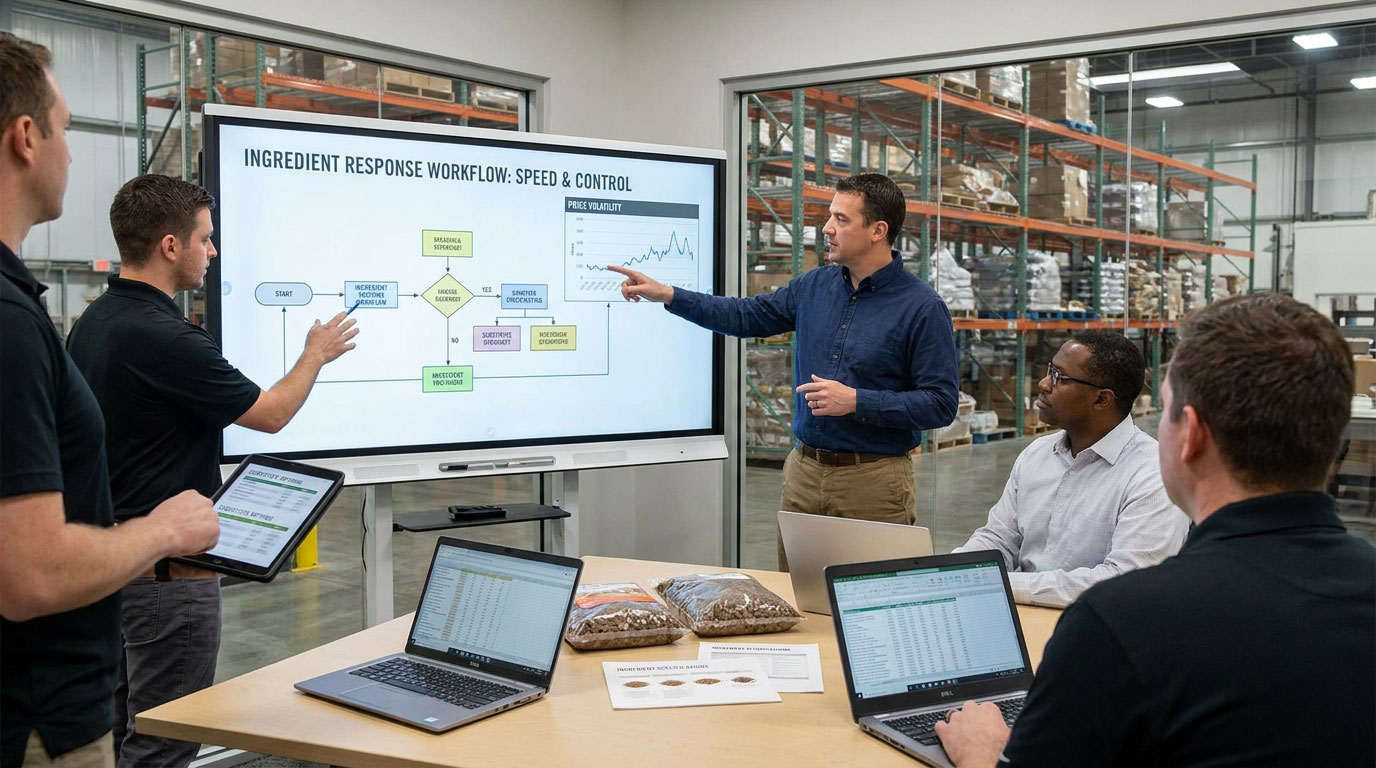
Challenge 1: Fragmented tooling creates serial workflows. In most organizations, formulation logic is split across spreadsheets, a legacy LP solver, and offline R&D notebooks. Each handoff between them is manual. A reformulation request travels:
Formulator → Solver → Spreadsheet validation → Email approval → PLM re-entry, and any error sends it back to the start.
The workflow is serial because the tools are disconnected, and serial pet food formulation workflows cannot be fast.
Challenge 2: Single-objective solvers force sequential compromise. Legacy least-cost solvers answer one question: "What is the cheapest recipe that meets nutrient minimums?" Modern briefs however, carry three or four objectives like cost, nutrition, sustainability, and performance. Teams end up optimizing for cost, then manually adjusting for sustainability, then re-checking nutrition, and finally looping until something acceptable emerges. Each loop can take a day or more.
Challenge 3: Price volatility outruns the reformulation cycle. When a commodity price moves, the value of reformulating decays daily. If your pet food reformulation cycle takes six weeks, procurement is also locked into unfavorable sourcing for six weeks, or ships product at a compressed margin. The cost of slow formulation shows up in COGS, not in the R&D budget, which is why it often goes unmeasured.
Challenge 4: Compliance is verified, not built in. When nutritional standards (AAFCO profiles, therapeutic specs, urine pH, ME targets) live in reference documents rather than in the optimization model itself, every candidate recipe requires manual compliance review. Quality teams become a checkpoint instead of a partner, and manual review is where errors can slip through.
Challenge 5: Institutional knowledge is unauditable. Why did we substitute ingredient X in 2023? Which spec did version 4 fail? If the answer lives in a senior formulator's memory or an email thread, the organization carries key-person risk and struggles during regulatory and formulation compliance reviews.
The solution: Make the constraints part of the model
Cambridge PetTech's FormuLogic addresses all five challenges with one architectural decision. It puts every objective, constraint, and approval into a single connected system. This creates a unified formulation workflow in which ingredient data, nutritional requirements, cost models, scenario planning, and approvals remain connected.
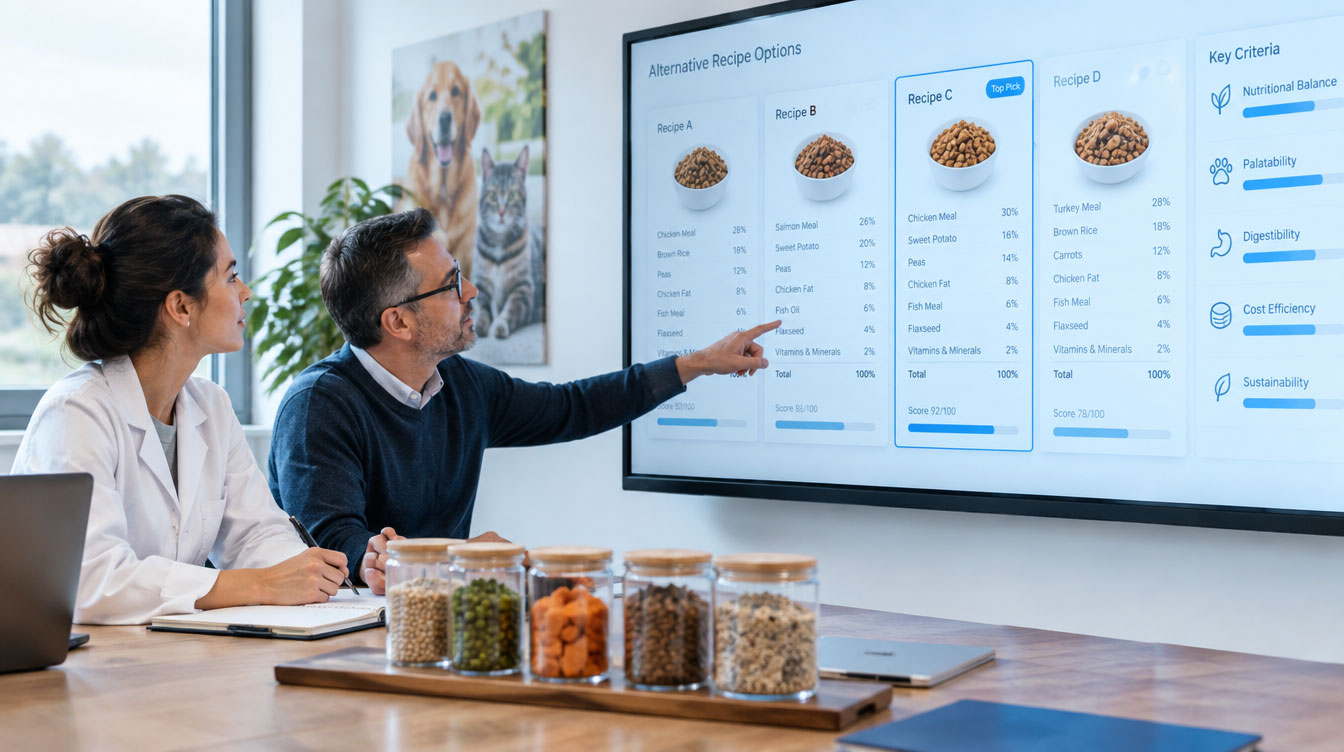
Multi-objective optimization ends sequential compromise. Teams run cost, nutrition, sustainability, and performance in a single model and control the trade-offs directly, with constraints for nutrients, cost, ME, and pH. Scenario generation ends serial iteration. FormuLogic produces 50+ valid pet food formulation scenarios per optimization run in minutes, compared side by side, so choosing a formulation becomes a business decision. Substitution groups end the volatility lag enabling ingredients to adjust automatically for price and availability, while procurement sees the real-time cost impact of every substitution through ingredient substitution modeling. Custom specs end after-the-fact compliance wherin AAFCO defaults, brand-specific, and therapeutic requirements are applied to every candidate and every revision automatically. Version history with differences, configurable approvals, and a complete audit trail ends unauditable tribal knowledge by creating a traceable formulation audit trail and searchable record of every decision.
Key capabilities mapped to each challenge
Business value
The value story differs by seat. For the CFO and BU leader, faster reformulation converts directly to margin protection during commodity swings and to a 75% reduction in trial costs per launch SKU. FormuLogic also creates a more responsive approach to pet food margin optimization when ingredient costs change. For the VP R&D, a 70% reduction in formulation creates additional capacity: the same team runs more experiments, explores more white space, and attaches reasoning to every decision. Faster pet food recipe development also helps R&D teams move more viable concepts through the innovation pipeline. For procurement, scenario modeling for commodity volatility turns sourcing from reactive to proactive. For quality and regulatory, compliance-by-construction reduces manual errors and makes audit response a query, not a project. Centralized formulation data and automated nutritional compliance checks also support more consistent regulatory review. Across all seats, a 5x improvement in brief-to-shelf time is the difference between leading a category trend and following it.
Enterprise use cases
Commodity shock response
Re-optimize an entire affected product family against new price inputs within a working day.
Margin engineering
Set explicit cost targets per SKU and let FormuLogic find compliant formulations that hit them, rather than discovering cost post-hoc.
Supply disruption
When an ingredient becomes unavailable, substitution groups surface pre-validated alternatives with full nutritional and cost impact.
Sustainability commitments
Quantify exactly what each sustainability improvement costs per recipe, enabling honest, funded commitments instead of aspirational ones.
An illustrative customer scenario
A composite example: a manufacturer's private-label division receives a retailer request to hit a lower price point on a canned line within one quarter.It needs to be done without changing the guaranteed analysis panel. Under the legacy process, the team would model two or three candidate recipes and hope one clears review. On Cambridge PetTech's FormuLogic, formulators set the cost target and constraints, generate dozens of compliant candidates in a single run, compare sustainability and palatability trade-offs side by side, and route the chosen recipe through electronic approval with the full decision trail attached. The retailer's deadline is met with margin intact. The reasoning is documented for the next negotiation.
Implementation overview
Teams typically begin with the category where ingredient price and commodity market volatility hurts most. Phase one loads ingredient composition, cost, and sustainability data and encodes nutritional standards. This creates a centralized ingredient database and a single source of truth for all formulation decisions. Phase two connects ERP/PLM systems so cost inputs stay current and outputs flow downstream. FormuLogic supports enterprise formulation software integration and formulation data management. Phase three configures approval workflows and role-based access to mirror your governance model. Legacy-parallel validation runs before cutover.
Best practices
Measure your current pet food reformulation cycle time honestly before deployment. It becomes your ROI baseline. Track the time spent on data collection, solver iterations, compliance reviews, approvals, and PLM re-entry to identify where FormuLogic's formulation workflow automation can deliver the greatest value. Give procurement its own view early; real-time ingredient cost-impact visibility and substitution analysis are the fastest internal proof points. Encode therapeutic and brand specs before running scenarios at scale, so every generated candidate is admissible and compliant by design. Publish the audit trail internally. When teams see how, when, and why formulation decisions are documented, trust in the new workflow compounds.
If a commodity price moved 15% tomorrow, how long would your reformulation response take? If the answer is "weeks," the gap is architectural. See how Cambridge PetTech's FormuLogic, an AI-powered pet food formulation software can help reduce reformulation cycle time, improve ingredient cost optimization, and accelerate compliant product development. Schedule a demo at sales@cambridgepettech.com or book an AI Discovery Workshop to map your current formulation workflow against a unified model.
FAQs
Why do reformulation cycles take so long in most pet food companies?
Because tooling is fragmented — spreadsheets, single-objective solvers, and offline notebooks force serial, manual pet food formulation workflows, with compliance checked at the end. Disconnected ingredient data, cost models, nutritional requirements, and approval processes add further delays to the pet food reformulation cycle.
Can FormuLogic really reduce cycles from weeks to hours?
Cambridge PetTech's FormuLogic is designed to reduce pet food reformulation cycle time from weeks to hours by generating and comparing 50+ compliant pet food formulation scenarios per run. With published outcomes of 70% faster formulation time, multi-objective formulation optimization allows cost, nutrition, sustainability, and performance requirements to be evaluated together rather than through sequential manual iterations.
How does FormuLogic help during ingredient price volatility?
Substitution groups adjust for price and availability, procurement sees the real-time cost impact of every substitution, and teams can set cost targets and re-optimize quickly. FormuLogic allows pet food manufacturers to perform ingredient substitution analysis, raw material cost optimization, and supply disruption modeling without restarting the formulation process.
Does faster mean less compliant?
The opposite. FormuLogic enables custom specs, AAFCO profiles, urine pH and ME targets that are applied to every candidate automatically, with a complete audit trail on every change.
What systems does FormuLogic connect to?
Connectors are available for SAP, Oracle, NetSuite, and major PLM systems, plus lab-notebook handoff. FormuLogic's pet food formulation software integrations allow ingredient data, cost inputs, formulation results, and approved outputs to move through existing enterprise workflows.