

In January 2021, Midwestern Pet Foods expanded a recall to include specified corn-containing dog and cat foods made at its Chickasha facility because they could contain aflatoxin above acceptable limits. The announcement, published by FDA, illustrates how an ingredient-related safety issue can affect multiple products. It does not document the company's subsequent formulation decisions. [1]
For a formulation team, the practical question is immediate: If an approved material is placed on hold, which recipes can support upcoming production using cleared ingredients? Finding another material with similar crude protein is only the beginning. The replacement must preserve the product's nutritional requirements, performance expectations, and manufacturing suitability.
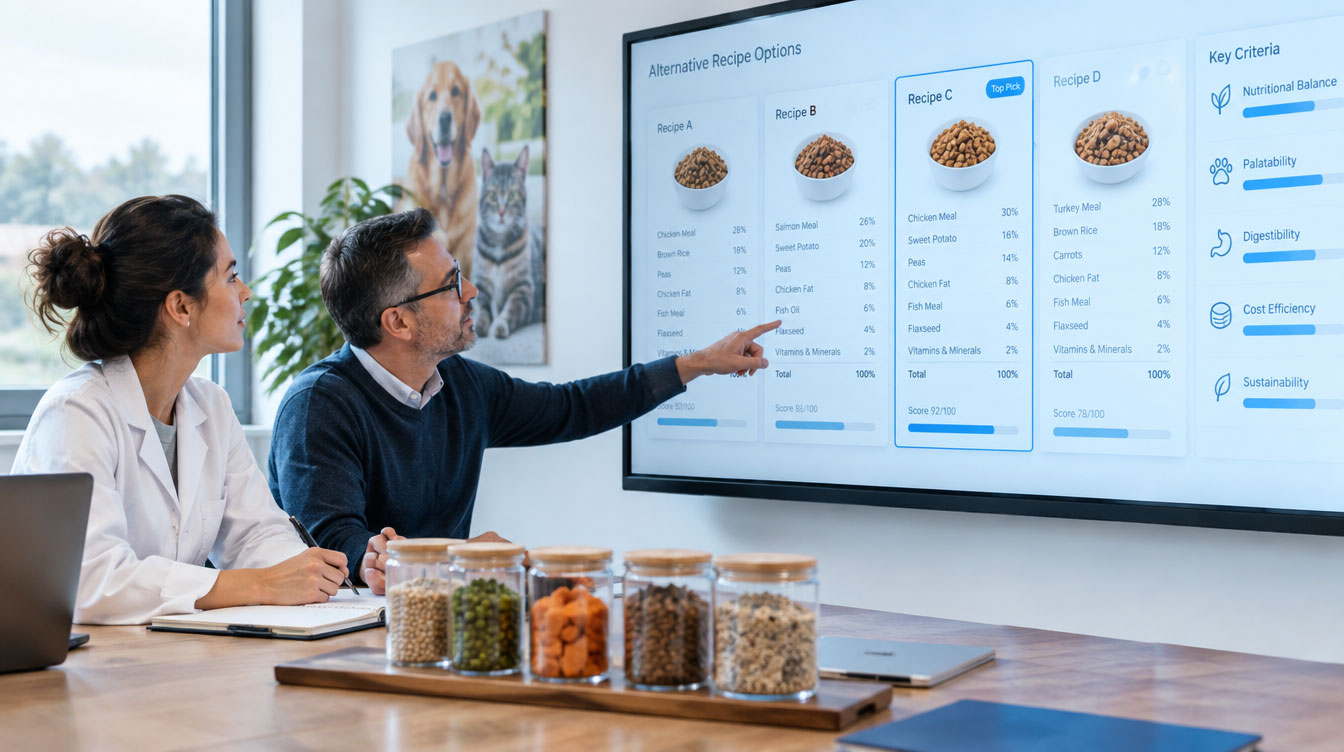
A useful response produces several workable formulations and explains why each deserves consideration. Ten is a shortlist, not a quota: Fewer well-supported alternatives are better than ten minor variations that leave the same problem unresolved.
What changes first when an ingredient becomes unavailable?
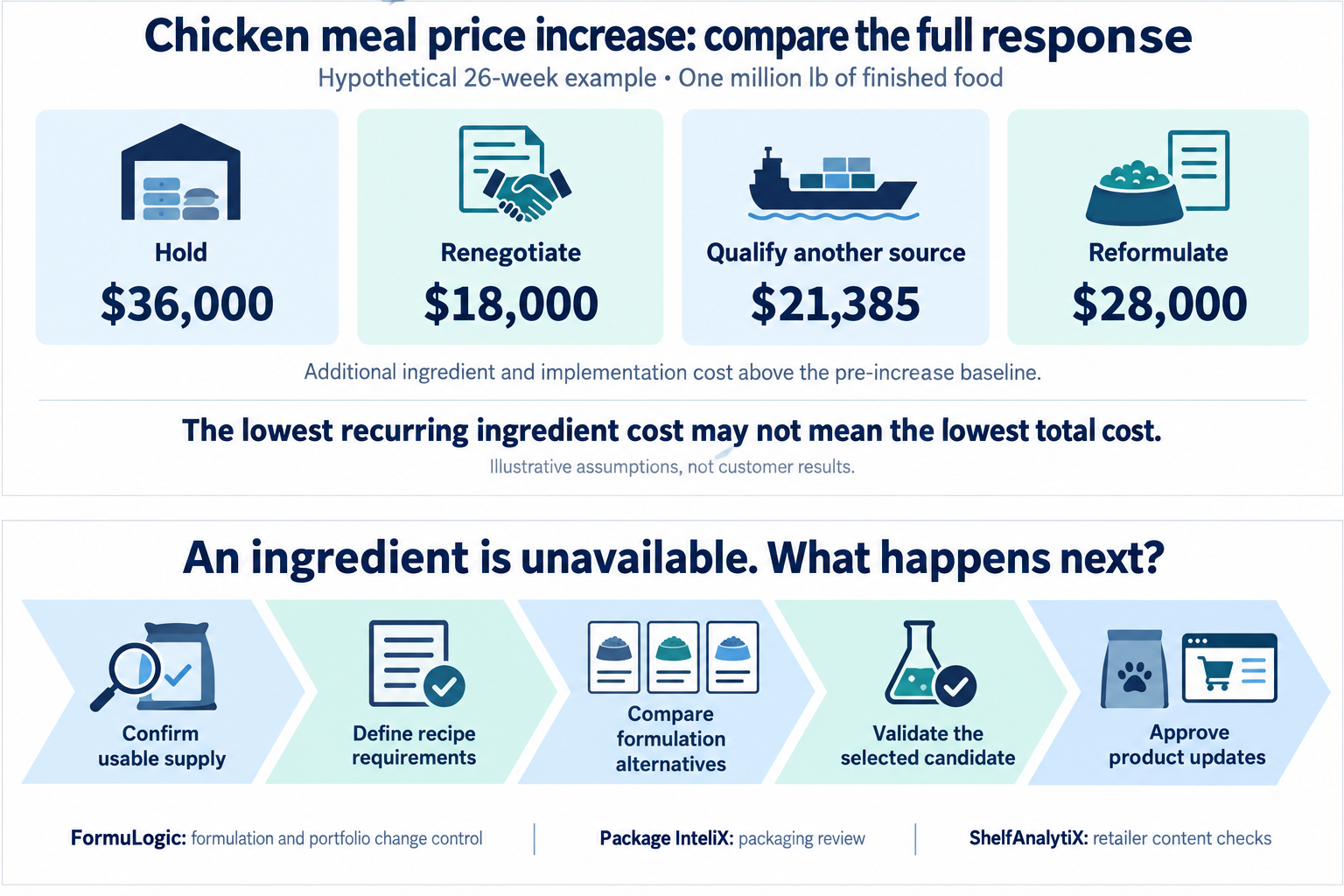
Update usable availability for the affected production period and identify the recipes that depend on the material. Distinguish a delayed shipment, a partial shortage, and a quality hold.
A quality hold may apply to particular lots or a supplier, rather than every source of that ingredient. Use the restriction confirmed by quality and procurement. Exclude held material from candidate generation; formulation changes do not establish that suspect stock is safe to use.
Record the incumbent recipe versions, approved ingredient specifications, production window, and usable quantities. Check whether another approved source can meet the same specification before changing the recipe. If substitution is necessary, evaluate the ingredient's full contribution to each affected product.
Can a least-cost run provide the replacement?
Yes. A correctly constrained least-cost run provides a useful baseline. It can include nutrient limits and ingredient restrictions; having several constraints does not make it a multi-objective formulation. FAO's formulation chapter describes these principles. [2]
The development decision may require several alternatives. One candidate may minimize ingredient cost, another preserve more of the approved recipe, and another use a readily qualified source. Keep mandatory requirements separate from the priorities used to compare eligible candidates.
If no candidate satisfies the requirements, report infeasibility. Any proposal to revise a specification or permitted ingredient list needs an explicit decision before the search is repeated.
What must the replacement actually replace?
Match the missing nutritional and functional contributions across the complete recipe. Similar ingredient names or crude protein values do not establish equivalence.
For a protein ingredient, review amino-acid contributions, minerals, fat, and relevant process characteristics. A replacement can require compensating changes elsewhere. For a specified fatty-acid source, check the required fatty acids individually rather than matching total fat alone.
Questions to resolve before advancing a replacementRequirementWhat the formulator should establishNutritionApplicable minimums, maximums, ratios, energy targets, and calculation basisIngredient eligibilityApproved specifications, supplier restrictions, exclusions, and inclusion limitsSupplyCleared quantity, delivery timing, and availability for the production windowPerformanceDefined palatability or digestibility endpoints, thresholds, and supporting evidenceManufacturingEstablished process limits and any additional trials requiredProduct commitmentsCustomer specifications, ingredient identity, and requirements supporting claims
Some requirements enter the model directly; others need review or testing. Passing the encoded constraints identifies a candidate for further evaluation, not a finished product ready for release.
How should palatability influence the shortlist?
Compare candidates against a defined control and enforce the agreed threshold where palatability is a hard constraint. A favorable cost cannot compensate for missing that requirement.
Retain the control recipe version, comparative endpoint, and applicable test conditions. Ingredient-level experience can guide screening, but it does not establish how the revised recipe performs against the current product.
FormuLogic's customer-specific predictive modeling involves developing and validating models using customer data or tailoring integration of an existing model. Where predictions inform selection, retain their validation scope and uncertainty. A small predicted advantage needs sufficient support before it drives a decision.
What makes multiple solutions useful?
They should offer meaningful differences under the same assumptions. Compare formula costs in $/lb of finished product using consistent prices, yield assumptions, specifications, and production timing.
For example, a candidate retaining most of the existing recipe may require less development work than one using a new ingredient combination. That is a planning question to investigate, not a guaranteed advantage. Record outstanding qualification and validation work alongside ingredient cost.
For each candidate, show the replacement ingredients, inclusion changes, mandatory-constraint results, supply confirmation, predicted performance, and ranking rationale. Distinguish available evidence from assumptions awaiting confirmation.
FormuLogic's multi-objective, multi-solution optimization supports up to 50 ranked options, with three selected for deeper comparison. Its substitution workflow evaluates replacement combinations from one ingredient through N-ingredient blends. The value is a set of choices the team can examine and act upon.
What must change across the portfolio before release?
Identify affected products and variants, then coordinate formula, packaging, and product-information approvals. Approval of one candidate does not automatically authorize every product using a related formulation.
FormuLogic's built-in PLM connects Product Families, Products, and Variants, supporting cost and nutritional impact review before implementation. Version history and approval workflows help preserve which formulation was selected and why.
Ingredient substitutions can change declarations even when ingredient order stays the same. FDA describes ingredient listing by common or usual name in descending order by weight. [3] Package InteliX supports reviewing ingredient statements, claims, and artwork against approved product inputs.
Where the revised product changes online information, ShelfAnalytiX supports comparing retailer listings and packaging images with approved product information. Coordinate updates with the product transition so consumers are not shown outdated ingredients or claims.
Plan these reviews while building the shortlist. Qualification, manufacturing trials, customer approvals, and packaging changes can determine which otherwise feasible candidate is practical for the required date.
Which formulation should the team advance?
Advance the candidate whose technical evidence, supply, and implementation plan best meet the brief. R&D establishes formulation feasibility; quality, manufacturing, procurement, and regulatory teams confirm the conditions for release.
Record the selected recipe, unresolved questions, and evidence required before implementation. Keep another useful alternative available where practical, and revisit the comparison if supply timing or specifications change.
Our guide to responding to ingredient price and supply changes covers the broader process. Explore FormuLogic for formulation alternatives and portfolio change control that help teams turn an ingredient disruption into a reviewable production decision.
Sources
- Midwestern Pet Foods. Midwestern Pet Foods Voluntarily Expands Recall of Pet Food for Aflatoxin Health Risk. Company announcement published by FDA, January 11, 2021. Historical recall; the FDA page states that the recall has been terminated.
- Chow KW, Rumsey GL, Waldroup PW. Chapter 16: Linear Programming in Fish Diet Formulation. Food and Agriculture Organization of the United Nations. Supports the explanation of formulation objectives and constraints.
- US Food and Drug Administration. Animal Food Labeling and Pet Food Claims. Federal ingredient-declaration requirements.