

The business problem: Formulation expertise doesn't scale, and solver interfaces don't help
Formulation is a deep-expertise discipline. A senior nutritionist holds years of knowledge about ingredient interactions, palatability trade-offs, and regulatory nuance. However, translating that knowledge into a legacy solver means wrestling with constraint matrices and parameter syntax. The interface, not the science, becomes the bottleneck. Junior formulators often face a steep ramp while senior formulators spend expert hours on mechanical setup; and adjacent stakeholders like procurement, and product managers. One can't interrogate the model at all without going through R&D. This limits formulation knowledge sharing, slows pet food product development, and makes specialist expertise difficult to scale across the organization.
Meanwhile, executives asking "can AI accelerate our R&D?" often get pitched generic AI tools that hallucinate confidently about nutrition. That’s an unacceptable risk in a regulated, animal-health-adjacent category. The genuine opportunity sits between those extremes. Grounded AI for formulation that accelerates expert workflows within hard scientific constraints and produces explainable, traceable results.
The solution: Conversational intelligence on top of rigorous optimization
FormuLogic's architecture pairs two layers. Underneath sits a multi-objective optimization engine with explicit constraints like nutrients, cost, metabolizable energy (ME), pH, custom and therapeutic specs. On top sits a conversational AI workspace where formulators create recipes using natural language, ask formulation questions, and get instant guidance. The AI accelerates interaction with the model, and the model enforces the science. This is the critical design distinction. The AI operates against your ingredient database, your specs, and your constraints. FormuLogic's grounded architecture combines natural-language formulation software with rigorous pet food recipe optimization, rather than replacing scientific decision-making with generic AI outputs.
Three properties make this enterprise-grade:
Explainability. Every decision FormuLogic supports is explainable and auditable. Trade-off transparency on cost, nutrition, palatability, and sustainability is built into scenario comparison, and teams can attach reasoning to every decision.
Control. Formulators set the objectives and constraints; FormuLogic generates candidates. Choosing among 50+ valid pet food formulation scenarios remains a human, business-priority decision.
Isolation. Your formulations, ingredient data, and models remain fully isolated with no shared training, no cross-customer reuse, and no external exposure. Your proprietary formulation IP never improves a competitor's results. This protects formulation data privacy and proprietary recipe intellectual property while supporting enterprise AI governance.
Key capabilities
Natural-language recipe creation
Describe the brief conversationally instead of encoding constraint matrices. It makes complex pet food recipe formulation more accessible without removing scientific controls.
Instant formulation guidance
Ask questions mid-workflow and get answers grounded in your data and specs. No generic nutritional information.
Automated scenario generation
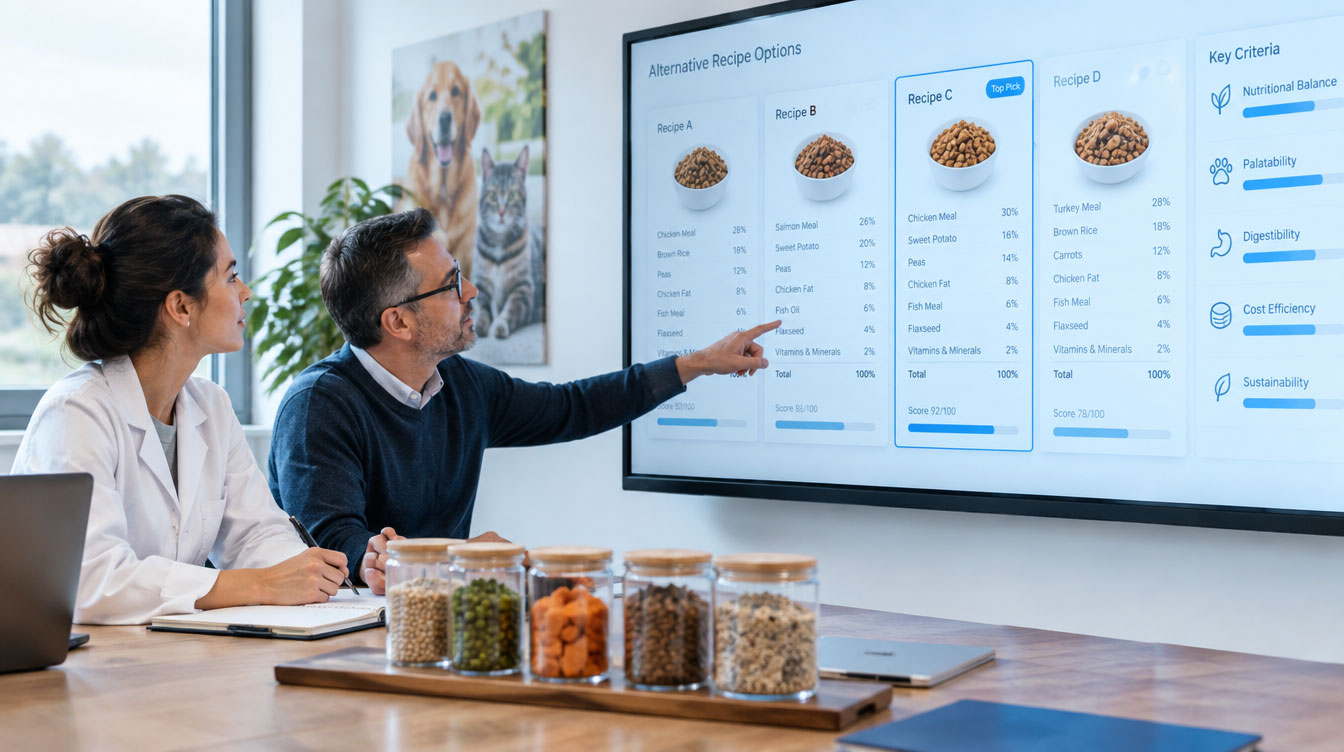
50+ valid formulation scenarios per optimization run, in minutes. Supports rapid recipe optimization and side-by-side formulation scenario comparison.
Automated substitution intelligence
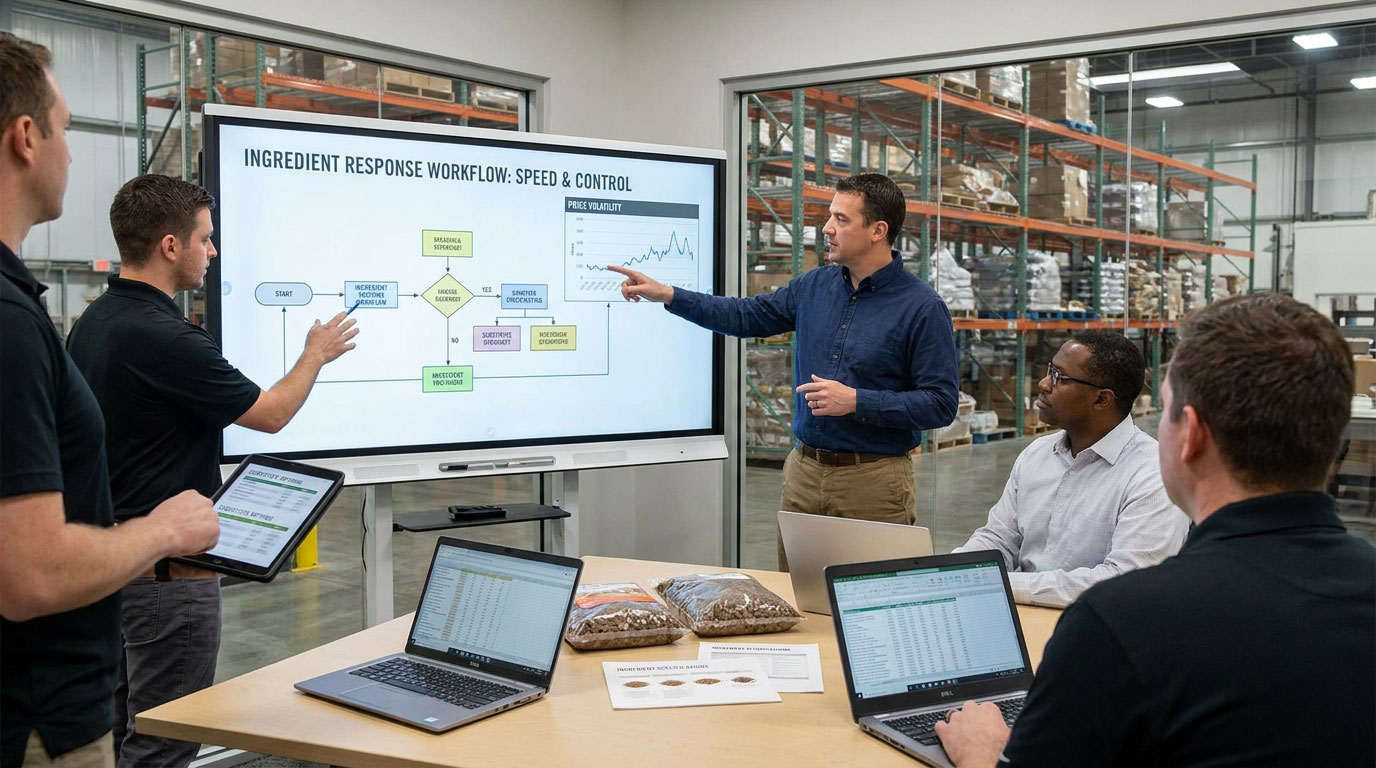
Substitution groups adjust automatically for ingredient price and availability. Enables real-time ingredient substitution analysis and formulation cost optimization.
Automated compliance application
AAFCO profiles, urine pH, ME, and custom specs applied to every candidate and revision without manual re-checking.
Workflow automation
Configurable approval routing with electronic sign-off, version history with diffs, and handoff to PLM, ERP, and lab notebooks.
Business value
For technical teams, the value is throughput and reach. Dozens of formulations run in parallel, including exploration that would never have been attempted under manual iteration, creating a dramatically lower barrier for junior formulators to be productive. FormuLogic also reduces time spent configuring legacy solver interfaces, allowing technical teams to focus more of their effort on formulation science and recipe development. For innovation leaders, conversational access democratizes the model. Product and procurement stakeholders can explore "what if" questions without queuing behind R&D. For executives, the published outcomes quantify it: 70% faster formulation versus legacy LP solvers and 75% lower trial costs per launch SKU. Because computational exploration replaces physical trial-and-error for early-stage screening, AI-assisted formulation optimization creates value through faster product development, reduced formulation cycle time, and more efficient use of physical trials. For risk owners, explainability plus audit trail means AI adoption strengthens governance rather than weakening it.
Enterprise use cases
● Brief-to-candidates in one session: A product manager's launch brief becomes a ranked set of compliant candidate recipes the same day.
● Expert leverage: Senior nutritionists encode their standards once (custom specs, therapeutic requirements) and the platform enforces them on every scenario, scaling expertise across the team.
● Cross-functional what-ifs: Procurement asks, in plain language, what a substitution does to cost and nutrition — and gets a grounded answer instantly.
● Sustainability exploration: Generate scenario sets that vary sustainability improvement levels and see the cost curve, turning abstract goals into concrete options.
An illustrative customer scenario
A composite example: A nutritionist at a therapeutic-diet manufacturer needs a urinary-care formulation variant with a lower cost basis. She describes the brief in natural language covering target species, urine pH range, ME window, guaranteed analysis constraints, and cost ceiling. Using Cambridge PetTech's conversational AI formulation workspace, the FormuLogic platform generates a scenario set in minutes; she filters to candidates meeting the therapeutic spec, compares three finalists on palatability-relevant composition and sustainability profile, attaches her reasoning, and routes the selection for electronic approval. What previously consumed two weeks of solver configuration and manual compliance checks concludes in an afternoon, fully documented for regulatory review. The result is an explainable, audit-ready pet food formulation workflow that combines recipe cost optimization with therapeutic and nutritional constraints.
Implementation overview
AI value follows data readiness.
Step one
Structure the ingredient database (composition, cost, sustainability attributes). It's the ground truth the AI operates on. A governed ingredient database gives the formulation AI accurate, organization-specific information on which to base its guidance and optimization scenarios.
Step two
Encode nutritional standards and therapeutic specs so that generated scenarios are compliant by construction. This embeds nutritional requirements and AAFCO formulation compliance directly into the optimization model.
Step three
Enable the conversational workspace for the formulation team and run parallel validation against legacy solver outputs to build trust.
Step four
Extend access to procurement and product stakeholders with role-based permissions, enabling controlled, cross-functional access to formulation scenario planning and ingredient substitution analysis.
Best practices
Treat the ingredient database as a governed asset. AI guidance is only as good as its ground truth. Ingredient data quality, nutritional accuracy, and consistent cost information are foundational to reliable AI-powered formulation. Start conversational workflows with your most experienced formulators; their validation converts skeptics fastest. Require reasoning attachments on scenario selections from day one to build the decision corpus and strengthen formulation knowledge management. Use the parallel-run phase to publish accuracy comparisons internally. Trust in AI is earned with evidence, not mandates.
The question isn't whether AI belongs in formulation. It's whether the AI you adopt is grounded, controllable, and explainable. See Cambridge PetTech's AI-powered pet food formulation software, FormuLogic operates against real constraints. Schedule a demo at sales@cambridgepettech.com or watch the platform overview video at cambridgepettech.com/formulogic.
FAQ
Does the AI invent nutritional values?
No. The conversational layer in FormuLogic operates against your ingredient database, nutritional standards, and constraints. The optimization engine enforces nutrient, cost, ME, and pH requirements on every candidate. This grounded AI formulation approach uses organization-specific data and defined scientific constraints instead of generating unsupported nutritional values.
Will our formulations train models used by other companies?
No. Formulations, ingredient data, and models remain fully isolated across FormuLogic. That means no shared training, no cross-customer reuse, no external exposure. This protects proprietary pet food formulations, ingredient data, recipe IP, and customer-specific optimization models.
Do formulators lose control to the AI?
Formulators set objectives and constraints, and make the final selection among generated scenarios. Every decision carries attached reasoning and a full audit trail. The platform, FormuLogic uses a human-in-the-loop AI model in which formulation experts retain control over scientific requirements and final recipe decisions.
How many scenarios can it generate?
50+ valid formulation scenarios per optimization run, typically in minutes. Teams can compare cost, nutrition, sustainability, performance, and other formulation trade-offs across these scenarios.
Can non-experts use it?
The natural-language interface lets product and procurement stakeholders explore formulation trade-offs safely, while role-based access controls what each user can view, edit, approve, or deploy. This enables controlled, self-service formulation scenario planning without bypassing R&D oversight or nutritional constraints.