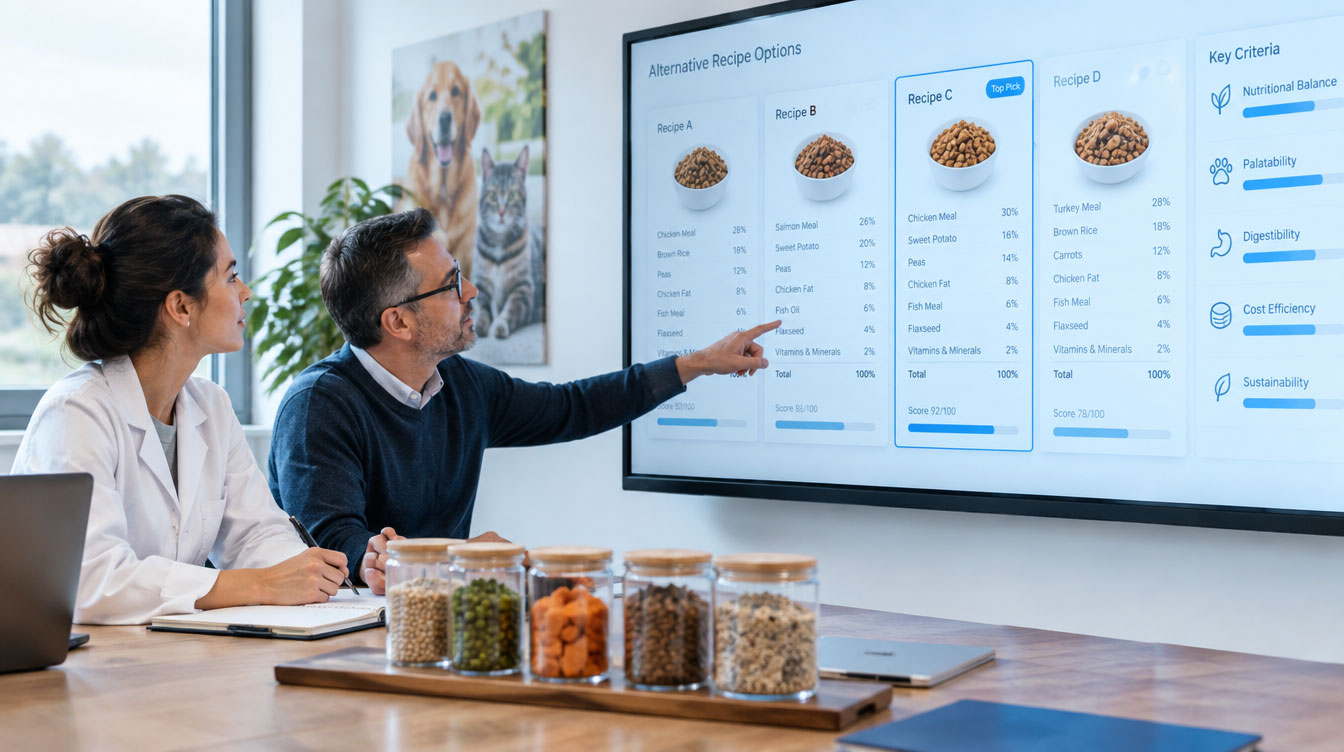


Suppose a team proposes replacing pea protein isolate with whey protein concentrate in a shared base recipe. The revised formulation meets its nutritional specification. Two branded pack sizes use the base, and a retailer sells a third product made from it.
The formulator can explain the ingredient and nutrient differences. Can the team identify which approved product versions will adopt the change, which declarations need updating, and which packaging can be used for the first production run?
Those questions sit at the boundary between formulation and product lifecycle management. Pet food PLM links formula versions with products, specifications, approvals, and downstream records so that a proposed change can be assessed and introduced deliberately.
The practical test is straightforward: before a revision reaches production, the team should be able to show what it affects, what was approved, and which versions are authorized for use together.
Which products does a formula revision actually affect?
Start with the products that reference the affected formula version, then examine inherited values, variant overrides, and independently maintained copies.
A product family name is not enough. Two products can share a commercial family while using different recipes. Conversely, one approved formula can supply several pack sizes, retailer products, and market-specific labels.
A copied recipe also needs careful treatment. Its origin may be useful history, but an independently maintained copy does not necessarily adopt later changes to its parent. The relationship must be explicit.
Consider this hypothetical dependency map. A proposed revision 8 would replace revision 7 of formula F-12:
This map identifies review scope. It does not authorize all three F-12 products to move to revision 8. One may remain on revision 7 until its customer approval or packaging transition is complete.
Does every formulation revision require a label change?
Every revision should receive a proportionate label-impact assessment. Change the label when the revised product no longer supports the existing declaration or other required information.
Ingredient identity and ingredient order both matter. US federal rules generally require ingredients to appear by their common or usual names in descending order of predominance by weight. Replacing a named ingredient can require a declaration amendment even when its position stays the same. [1]
Nutrient estimates require a different comparison. AAFCO explains that guaranteed values are expressed as minimums or maximums, depending on the nutrient. They are not an exact transcription of every calculated composition value. [2]
For example, a hypothetical reduction in calculated crude protein from 29% to 28% does not, by itself, establish that a declared 26% minimum must change. The review still needs adequate evidence that the guarantee remains supportable, including relevant manufacturing and ingredient variability.
Record a decision to retain existing wording as carefully as a decision to amend it. "Reviewed and unchanged" is useful evidence; silence leaves the next reviewer guessing.
What should a change-impact report show?
Show the proposed difference, the affected record, the review owner, and the decision needed before implementation.
A long list of linked files is only a starting point. Each item needs a disposition: revise, retain with justification, obtain evidence, or exclude from this implementation.
These responsibilities should be adapted to the organization. The important point is to assign decisions, not simply distribute notifications.
Keep claims specific. An ingredient exclusion, a nutritional claim, and a performance claim require different evidence. Do not import human-food allergen-labeling assumptions: FDA explicitly states that the food-allergen labeling requirements discussed in section 403(w) do not apply to pet foods or animal feeds. [3] Ingredient declarations and product-specific commitments still need review.
Can one formula support both US and EU label records?
Yes. Shared formulation data can support separate market-specific records, each with its applicable rules, language, and approval status.
The difference goes beyond changing a heading from "Ingredients" to "Composition." The FEDIAF labeling code describes declaration by specific feed-material names or permitted categories, with the corresponding weight ordering. It also addresses analytical constituents and tolerances. These distinctions affect how a formula change is evaluated against an existing EU label. [4]
Keep the legal framework separate from industry guidance. US labels are subject to applicable federal and state requirements. FEDIAF's code provides guidance to use alongside EU legislation. [5]
The record should therefore identify the destination market, applicable rule set, declaration approach, and approved wording. A supplier-origin change does not automatically mean the destination-market label changes; its actual consequences need assessment.
One formula can be the common reference while regulatory teams retain control of the different outputs.
What evidence belongs with the formula revision?
Preserve the reason for the change, the data used to evaluate it, the affected records, and the decisions authorizing its use.
A comparison of ingredient percentages explains what changed. It does not explain why the change was accepted.
Attach the relevant ingredient specifications, nutritional targets, cost assumptions, and supporting assessments to the revision. Identify the versions used. If a later ingredient specification changes, the original decision should remain understandable from its retained evidence.
Performance evidence needs the same discipline. Where a customer-specific palatability model informs the decision, retain the model version, the defined control recipe, the comparative endpoint, and the applicable threshold. Where palatability is a mandatory formulation constraint, a favorable cost cannot compensate for failing it.
Also distinguish measured results from predictions and record any outstanding validation. A model-supported candidate may be suitable to advance into testing without yet being authorized for production.
The change record should make that status obvious to everyone who receives it.
How do you prevent a new formula from meeting the wrong packaging?
Authorize the formula, label, and packaging versions as a compatible combination, and define when that combination becomes effective.
In the F-12 example, revision 8 might be ready before the retailer's new packaging arrives. A blanket instruction to "use the latest recipe" would ignore that difference.
The implementation plan should identify which products adopt revision 8, their approved artwork references, and the production point at which the change takes effect. It should also specify how remaining packaging is assessed and handled.
Existing packaging may remain usable if its information is still valid for the revised product. Where it is not, the team needs an approved disposition before use. Old and new formula versions may coexist during a controlled transition, but the permitted combinations must remain clear.
ERP and manufacturing workflows need those approved references. The release check should compare the production order with the authorized formula and packaging versions, with a defined response to a mismatch.
This is where an impact assessment becomes an executable change.
Where does FormuLogic's built-in PLM fit?
FormuLogic connects formulation with Product Families, Products, and Variants, supporting impact analysis before a change is implemented.
Its built-in product lifecycle management supports ingredient-change propagation across affected products and variants, with cost and nutritional impact analysis. Version history, differences between revisions, configurable approvals, and an audit trail keep the formulation decision traceable.
This gives the team a controlled starting point for downstream work. Labeling, artwork, and manufacturing records need the relevant approved information, whether managed through connected systems or defined handoffs. Responsibilities for those downstream decisions should remain explicit.
The distinction matters during an ingredient supply or price disruption. A technically feasible alternative still needs assessment across the products that may adopt it. The team can compare the formulation options while evaluating the work required to implement each one.
Generating a candidate, approving it, and releasing it are separate milestones. Measuring those stages separately also makes reformulation workflow improvements easier to evaluate.
How should an existing team begin?
Pilot one product family from proposed revision through production implementation before expanding the workflow.
First, map the current formula versions and their product, specification, label, and artwork references. Resolve ambiguous identifiers and independently maintained copies. Establish who owns each record and who can approve its revision.
Next, agree which differences trigger review, what evidence reviewers need, and how approved information reaches downstream systems. Automate checks only after the underlying relationships and decision rules are understood.
Then run a representative change through the complete process. Include a retained label as well as an amended one, a retailer approval if relevant, and a packaging transition. Confirm that the team can reconstruct both the decision and its first production use.
The pilot succeeds when people can answer a concrete question without reconciling competing files: which approved formula and packaging versions should this production order use?
Before approving your next ingredient change, ask for the affected product versions and the implementation decisions alongside the nutrient comparison. Explore FormuLogic to connect formulation decisions with portfolio impact and approval history.
Sources
- U.S. Food and Drug Administration. Animal Food Labeling and Pet Food Claims. See “Common or Usual Name” for ingredient identity and descending-weight declaration, and the discussion of federal and state requirements.
- Association of American Feed Control Officials. Labeling & Labeling Requirements. Guidance on mandatory label elements and expression of guaranteed values as minimums or maximums.
- U.S. Food and Drug Administration (January 2025). Questions and Answers Regarding Food Allergens, Including the Food Allergen Labeling Requirements o…. Question B.13, page 12, addresses pet foods and animal feeds.
- FEDIAF (October 2019). Code of Good Labelling Practice for Pet Food. Section 3.2.1.4 covers feed-material declarations; Annex III covers tolerances. Read alongside applicable EU legislation.
- FEDIAF. Labelling: FEDIAF Code of Good Labelling Practice and EU legislation. Explains the code’s role alongside the legal framework.