

The business problem: Formulation is a strategic function running on tactical tools
Ask a VP of R&D at a mid-size or enterprise pet food manufacturer where their formulation logic lives. Their honest answer is usually "in several spreadsheets, one aging solver license, and the heads of two senior formulators." That architecture worked when portfolios were small and ingredient prices were stable. For today's pet food and animal nutrition manufacturers, it no longer scales.
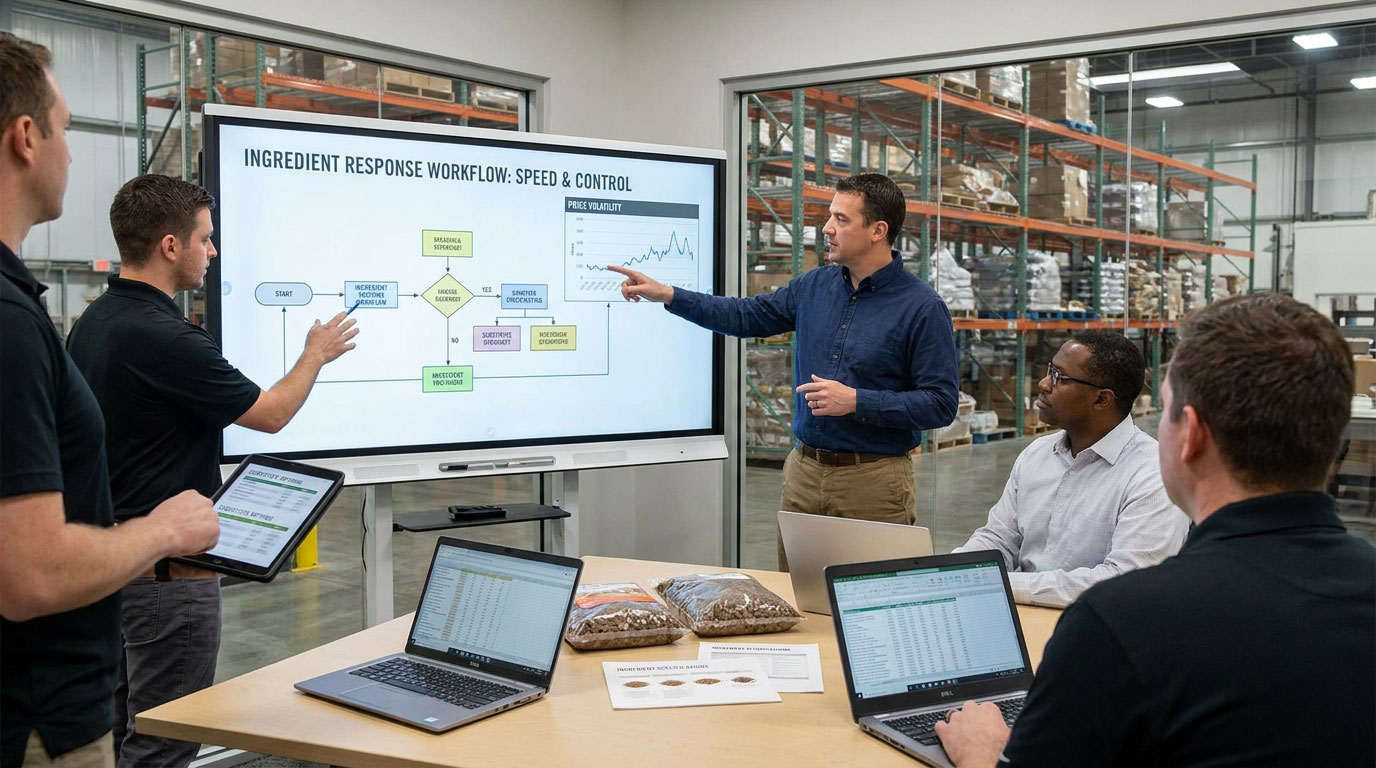
Three forces have converged on formulation teams. Ingredient cost volatility demands rapid reformulation, but each cycle through a legacy least-cost solver and manual validation takes weeks. This increases reformulation cycle time and limits how quickly teams can evaluate ingredient substitutions. Retailers and consumers now expect measurable sustainability commitments, which adds a third optimization objective that spreadsheet models were never built to handle alongside cost and nutrition. Add to it, the factors of regulatory expectations, AAFCO profiles, therapeutic specs, and urine pH targets. It translates to a simple fact. Every formulation decision needs a defensible trail, not a file.
The result is a strategic bottleneck that affects product development, procurement responsiveness, formulation compliance, and time-to-market. Product launches wait on formulation cycles. Procurement can't get fast answers on substitution impact when commodity prices move. Quality teams re-check work manually because nothing upstream is auditable. The cost isn't just formulator time. It's delayed revenue, missed cost-saving windows, and compliance exposure.
The solution: One platform, every trade-off, every decision explained
Cambridge PetTech's FormuLogic replaces that fragmented stack with seven tightly integrated modules built specifically for pet food and animal nutrition. Unlike disconnected feed formulation software and standalone optimization tools, the core idea of FormuLogic is simple. Bring cost, nutrition, and sustainability intelligence into a single model, so teams can explore multiple formulation scenarios, simulate trade-offs, and reduce petfood reformulation cycle time from weeks to hours. Every decision is explainable, auditable, and exportable to existing PLM and ERP systems.
Unlike legacy LP solvers that return a single least-cost answer, FormuLogic runs multi-objective optimization. Formulators can control the trade-offs between ingredient cost, sustainability goals, and nutritional targets in one model, with constraints for nutrients, cost, metabolizable energy (ME), pH, and more. This makes FormuLogic a more flexible least-cost formulation alternative for teams that need to optimize several business and nutritional objectives at once.
Key product capabilities
Multi-objective optimization
Balance cost, nutrition, sustainability, and performance in a single optimization run rather than sequential, siloed passes. This multi-objective formulation approach allows teams to evaluate competing priorities within the same formulation model.
Conversational AI workspace
Create recipes using natural language, ask formulation questions, explore AI-assisted formulation scenarios, and get instant guidance. No solver gymnastics. Then hand results off to your PLM, ERP, and lab notebook.
Scenario comparison
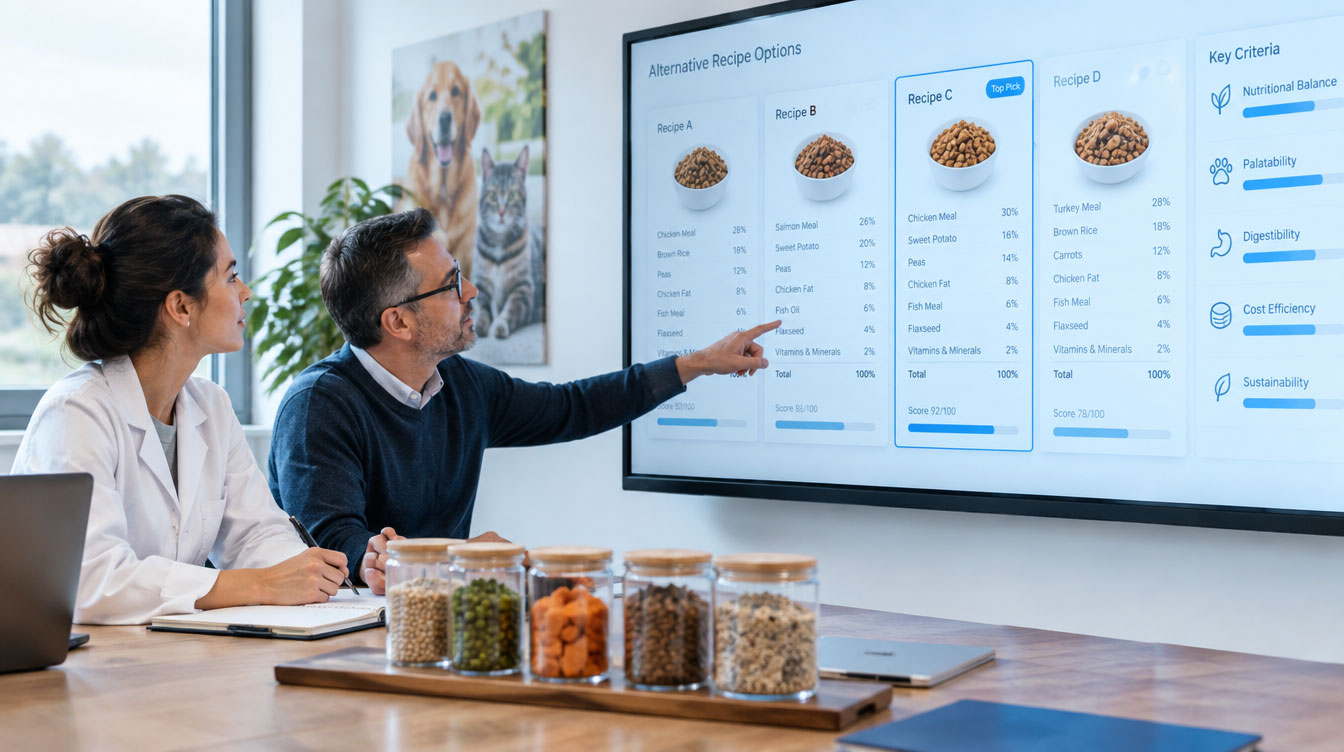
Generate 50+ valid formulation scenarios per optimization run in minutes, compare cost, nutrition, sustainability, and performance side by side, and choose the path that best fits business priorities. This gives teams a faster, more transparent way to evaluate pet food formulation trade-offs.
Real-world scenario modeling
Substitute ingredients and instantly see cost, nutrition, and sustainability impact. Set cost targets and re-optimize without starting from scratch each time ingredient prices, availability, or market conditions change.
Your own nutritional standards
Move beyond AAFCO defaults with custom nutritional specs, including brand-specific and therapeutic requirements. This allows teams to build AAFCO formulation compliance and proprietary nutritional standards directly into the formulation process.
Ingredient and substitution management
Build an ingredient database with composition, sustainability, and cost data. Create substitution groups that adjust automatically for ingredient price substitution and raw material availability. Centralized ingredient data management also helps formulation and procurement teams work from consistent, current information.
Full traceability
Version history with differences, configurable approval workflows with electronic sign-off, and a complete audit trail for compliance and formulation governance. Every formulation revision, approval, and decision remains traceable within the same system.
Business value: What leaders can expect
FormuLogic's published outcomes translate directly to the metrics executive buyers care about. Upto 70% faster formulation time versus legacy LP solvers means R&D capacity is effectively expanded without adding headcount. Upto 75% lower trial costs per launch SKU compounds across a portfolio — fewer bench iterations, fewer dead-end trials. Upto 5x faster time-to-market from brief to bench to shelf converts formulation speed into earlier revenue realization. Because sustainability objectives are optimized alongside cost rather than after it, they stop being viewed as a margin tax and become a managed trade-off.
For pet food and animal nutrition leaders, these improvements can translate into shorter reformulation cycles, more efficient product development, and faster responses to ingredient cost volatility.
For CIOs and CTOs, FormuLogic consolidates shadow tooling into a governed enterprise-ready pet food formulation software system with SOC 2 Type II controls, SSO/SCIM, role-based access, and deployment options spanning SaaS, dedicated VPC, or on-premise. Customer formulations and models remain fully isolated, and are never used for shared training.
Enterprise use cases
Portfolio-wide cost response: When a key protein price spikes, re-optimize affected SKUs across the portfolio within hours instead of triaging over weeks.
New product development: Run dozens of candidate formulations in parallel against a launch brief, with trade-off transparency on cost, nutrition, palatability, and sustainability.
Therapeutic and premium lines: Encode brand-specific and therapeutic specs (including urine pH and ME targets) so every candidate meets them automatically.
Sustainability roadmaps: Quantify the cost impact of sustainability improvements per recipe, and choose formulations that advance goals within margin guardrails.
Who it serves
R&D and formulation teams get faster iteration and greater experimentation through AI-powered formulation optimization and scenario comparison. Procurement teams get real-time cost impact of every substitution and scenario modeling for commodity volatility, with connectors to SAP, Oracle, NetSuite, and major PLM systems. Quality and regulatory teams get nutritional compliance applied to every candidate and revision, with end-to-end audit logs. Three roles, one platform, each with purpose-built views and a shared single source of truth.
An illustrative customer scenario
Consider a composite example. A premium dry-food manufacturer with 40 SKUs faces a sudden 18% increase in a core protein ingredient. In a spreadsheet-and-solver workflow, the reformulation queue would stretch across a quarter. With FormuLogic, procurement models the price change against substitution groups, while formulation generates compliant alternatives per SKU with cost, nutrition, and sustainability deltas side by side. Quality reviews each candidate against AAFCO and brand specs with a full audit trail. This compresses a quarter of triage into days, and protects margin in the same fiscal period as the price shock hit.
Implementation overview
Adoption typically follows four stages.
1. Load and structure your ingredient database with composition, cost, and sustainability data
2. Encode your nutritional standards — AAFCO baselines plus custom and therapeutic specs
3. Connect PLM/ERP systems (SAP, Oracle, NetSuite connectors available) and configure approval workflows and role-based access
4. Run the first optimization cycles in parallel with your legacy process to validate outputs before cutover.
This phased approach allows formulation teams to compare AI-powered optimization results with existing formulation methods before scaling the platform. The deployment model, whether SaaS, dedicated VPC, or on-premise is selected to match your security and data-governance policies.
Best practices
Start with one high-volume category to demonstrate formulation cycle-time gains before scaling. Involve procurement from day one. Substitution groups are where ingredient cost optimization value often shows up fastest. Encode custom specs early so every scenario is compliant by design. Treat the audit trail as a governance asset: configure approval workflows to mirror your actual sign-off chain, not an idealized one.
Formulation speed is now a competitive variable. See how your team can move from a formulation brief to an optimized product faster. Schedule a demo at sales@cambridgepettech.com, or book a tailored AI Discovery Workshop with Cambridge PetTech's animal health and technology experts.
FAQs
What is a FormuLogic?
FormuLogic is a pet food and animal nutrition formulation software that brings ingredient data, nutritional targets, cost, sustainability goals, and scenario planning into One connected workflow, replacing fragmented spreadsheets and legacy least-cost formulation software.
How is FormuLogic different from a traditional LP solver?
Legacy solvers optimize a single objective, usually cost. FormuLogic runs multi-objective formulation optimization across cost, nutrition, sustainability, and performance in one model and generates multiple comparable scenarios rather than one answer. It therefore provides a broader alternative to traditional least-cost formulation tools.
What results can teams expect?
Yes. Cambridge PetTech's FormuLogic reports up to 70% faster formulation time, 75% lower trial costs per launch SKU, 50+ pet food formulation scenarios explored per optimization run, and 5x faster time-to-market.
Does FormuLogic work with our existing PLM and ERP?
Yes. Cambridge PetTech's FormuLogic supports pet food formulation software integration with enterprise systems. Connectors are available for SAP, Oracle, NetSuite, and major PLM systems, with export to lab notebooks.
Is our formulation data protected?
Formulations, ingredient data, and models remain fully isolated, with no shared training or cross-customer reuse, under SOC 2 Type II controls, with SaaS, dedicated VPC, or on-premise deployment options. This helps manufacturers maintain enterprise data governance across their formulation workflows.