
AI in Pet Food Manufacturing: Four Irreversible Shifts Every Industry Leader Needs to Act On Now.
3,000 - That’s the number of new pet food products introduced every year in the US [1]. This makes the insights and operational efficiencies realized within a company’s R&D department a key competitive differentiator for pet food manufacturers.
To make matters more complicated, a new generation of AI tools across the manufacturing, compliance, retail, and consumer intelligence verticals is increasing the efficiency of market players and cutting their operational costs. These are not just merely improving existing processes — they are fundamentally reshaping and fitting them to meet the evolving business demands for faster, smarter innovation, enhanced rigor in product and packaging compliance, and an all-new level of marketplace intelligence.
We have seen that for executives and operational leaders who have spent years mastering the established playbook, the pace of this change can feel both exhilarating and disorienting.
The question is not whether AI will change the way pet and animal food gets developed, labeled, and marketed. The question now is whether your organization will adapt and adopt to this new paradigm, or will it hold on to outdated processes and continue to lose ground against more formidable competitors investing in change.
This article offers a practical lens into four areas where AI is creating irreversible shifts: Formulation, Packaging and Claims Compliance, Digital Shelf Management, and Market Intelligence. We will examine what is changing, why it matters to your bottom line, and what early adopters are already doing differently.
The New Science of Formulation: From Instinct to Multi-Objective Intelligence
Traditionally, pet food formulation has been equal parts art and science. Experienced formulators leveraged data from deep nutritional expertise, cost metrics, ingredient availability, and palatability to build recipes that deliver — in the food bowl and on the balance sheet.
So far, that approach has been enough, even if it was inherently limited by the cognitive bandwidth of even the most seasoned formulators.
Traditional formulation optimized for a relatively small number of variables in a sequence: first, meet nutritional requirements, then hit cost targets, then adjust for palatability. However, it was a linear process applied to a non-linear problem and confined to what could be done.
Emerging technologies have changed this formulation method. A survey [2] found that over 780 AgriFoodTech companies are currently using AI and machine learning models.
AI-powered multi-objective optimization fundamentally changes the architecture of this challenge. New platforms can simultaneously process hundreds of variables — nutrient profiles, ingredient costs, supplier availability, palatability scores, regulatory compliance thresholds, and consumer preference signals — to surface formulations that optimize across all of them at once.
- Formulation cycles that once took weeks of iterative adjustment can now be compressed to hours. An R&D team that could earlier evaluate a few dozen formulation scenarios in a development cycle can now evaluate thousands to surface the options that best balance cost efficiency, nutritional performance, and market positioning.
- When commodity ingredient prices shift — as they do constantly — reformulation decisions that once required days of analysis can now be modeled and evaluated in real time. The system can identify ingredient substitutions that preserve formulation integrity without sacrificing margins, and can do so across multiple brands and SKUs instantly.
- Palatability, historically one of the most difficult variables to quantify in advance, is increasingly being modeled through accumulated sensory data and behavioral feeding trial results. AI systems can now factor palatability risk into formulation decisions before a single prototype is built.
The implication of these advancements for manufacturers is significant. The cost advantage in formulation shifts from the company with the most experienced formulators to those with the best formulation intelligence infrastructure.
AI does not replace the formulator's expertise; it amplifies it. The organizations winning in this space are those that have put powerful AI tools in the hands of their best scientists.
Packaging and Claims Compliance: From Weeks to Hours
Ask any regulatory or quality assurance leader in the pet food industry about the cost of label compliance, and the story remains the same: it is time-consuming, resource-intensive, error-prone, and when it fails, it fails expensively and often going beyond the cost of a product recall.
The regulatory environment governing pet food labeling is layered. Navigating Association of American Feed Control Officials (AAFCO) guidelines, FDA requirements, state-specific regulations, and country-specific international standards is extraordinarily difficult to do manually at scale. Managing hundreds of SKUs across multiple markets makes compliance reviews a herculean task.
New AI-driven compliance platforms are fundamentally restructuring this landscape.
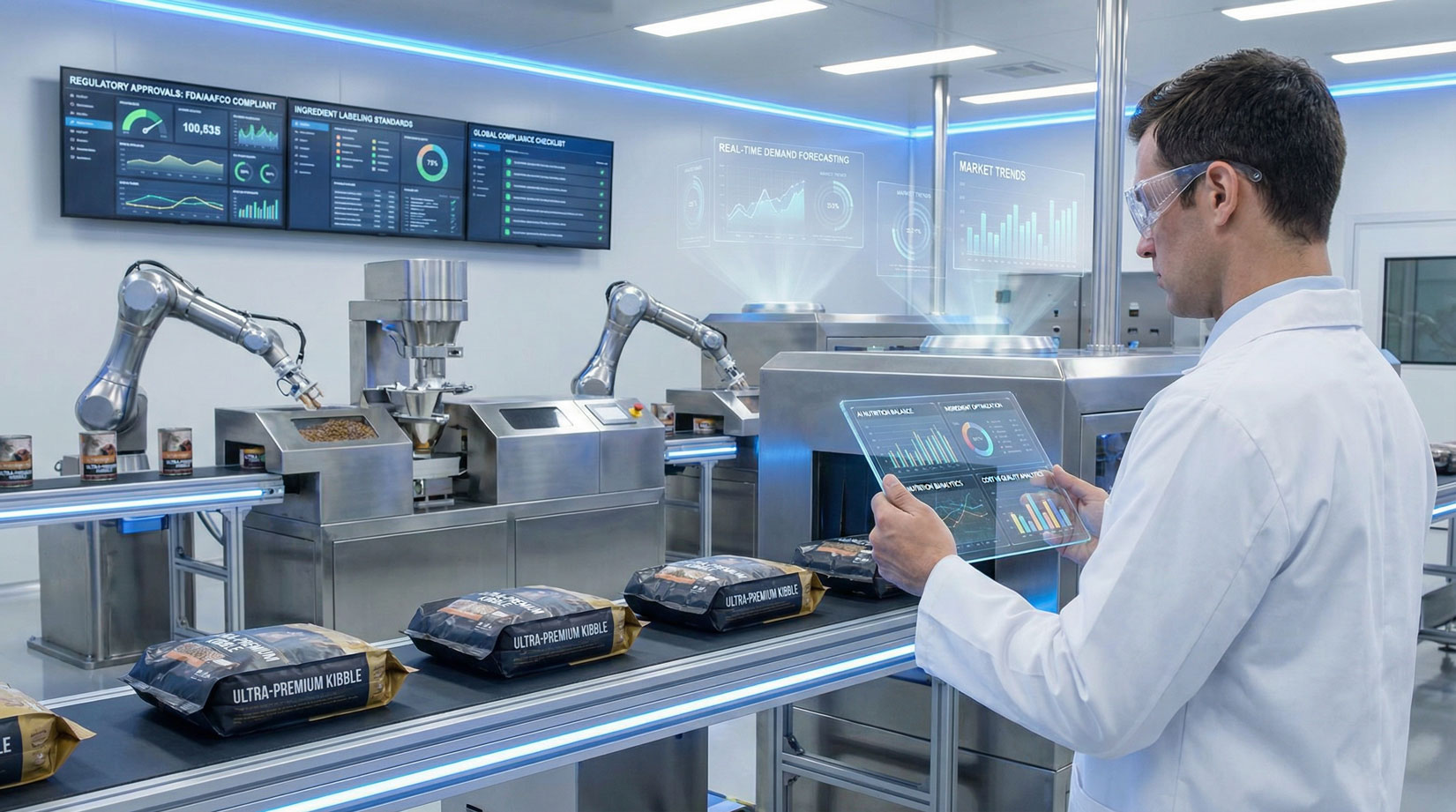
- Label review that previously required days of manual cross-referencing against regulatory databases can now be completed in hours. Platforms trained on current regulatory frameworks can flag non-conforming claims, missing required statements, ingredient declaration errors, and formatting violations automatically, before a label moves to print.
- With changing regulations, AI systems update compliance logic continuously. The manual process of tracking regulatory updates across jurisdictions and cascading label changes for review is being automated through monitoring and intelligent flagging.
- While launching new products or entering new markets, the compliance review process — which can become a bottleneck at the end of product development — can begin much earlier. It can run in parallel with formulation and packaging design, accelerating time-to-market.
AI tools are going beyond label compliance as well. They are becoming increasingly capable of evaluating packaging claims against competitive and regulatory benchmarks in real time.
The question, “Can I say this on my label?” is now being answered in minutes or hours, rather than weeks.
This represents a material shift in operating capability for innovation teams under pressure to launch.
Digital Shelf Intelligence: Where Pet Food Wins and Loses in the Modern Market
Digital shelves have become the norm for manufacturers and brands looking for engagement beyond brick-and-mortar retail. While some organizations may consider this the final frontier, the truth is that it is the platform from which the next shift is emerging.
Consumer purchasing behavior has moved online. To cater to it, businesses need a new category of AI-powered interactions that reshape how pet owners choose what to buy.
Intelligent product recommendation systems — or what the industry now calls AI shopping advisors — are increasingly embedded into the digital retail experience. From chatbots to entire recommendation architectures working in the background, these systems guide consumers through ingredient questions, life-stage nutrition needs, breed-specific dietary requirements, and product comparisons in real time.
For manufacturers, AI shopping advisors are both a challenge and an opportunity.
The challenge: Consumer purchase decisions are mediated by AI systems that dynamically weigh product data, review signals, nutritional claims, and pricing. Businesses need to optimize their products for these systems with complete, accurate, and compelling content — and this must work seamlessly at the moment of decision.
The opportunity: Brands that invest in the data infrastructure powering these systems and customer interactions can build a direct line to consumer purchase intent. Traditional systems cannot match this.
For product development teams, the implication is significant.
AI models can surface consumer questions like:
“What ingredients do pet owners ask about the most?”
“Which life-stage claims drive conversion?”
“Which formulation attributes generate the highest repeat purchase rate?”
These models can assign and define behavioral signals and route them back upstream.
This breaks down the wall between consumer behavior and R&D decision-making, enabling product pipelines informed not by quarterly research cycles but, by real-time consumer intent.
Market Intelligence: From Quarterly Reports to Real-Time Competitive Vision
Traditional market intelligence in the pet food industry looks something like this: syndicated sales data arrives with a monthly or quarterly lag, is interpreted by internal analysts, and eventually a PowerPoint reaches the leadership team's inbox. By the time decisions are made, the market has already moved on.
The pet food market’s velocity is being driven by new entrant brands, changing consumer preferences, ingredient cost volatility, and the complexity of omni-channel distribution. This makes quarterly intelligence cycles structurally inadequate for strategic decision-making. Organizations end up making long-cycle investment decisions based on data that is months old.
AI is fundamentally changing the economics and speed of market intelligence for pet food manufacturers.
- Aggregating and synthesizing signals across data sources like syndicated retail data, digital shelf performance, consumer review text, social conversations, ingredient commodity pricing, competitive product launches, and regulatory filings can now happen continuously. What analyst teams once compiled over weeks is now available as a daily intelligence stream.
- Pattern recognition across large, noisy datasets enables teams to detect early signals of consumer trends before they appear in syndicated data. It can flag competitive pricing shifts before they impact shelf velocity and identify ingredient availability risks before they disrupt supply.
- Leadership teams no longer need to wait for quarterly business reviews to understand market direction. AI-powered, near-real-time intelligence provides a fundamental upgrade in competitive positioning. Organizations that see the market earlier can make better decisions on innovation, distribution, and pricing.
The same AI infrastructure that surfaces market intelligence across retail channels is also beginning to close the loop with consumer behavior at the point of purchase.
When shopping advisor systems capture the questions consumers ask, the trade-offs they consider, and the moments they abandon a choice for a competitor’s product, that data becomes some of the most precise and actionable intelligence available.
It does not arrive months after the shelf interaction. It arrives as it happens.
For innovation teams, supply chain planners, and marketing leaders operating in a fast-moving category, this shift is not incremental but structural.
What This Means for Industry Leaders
These four areas of AI-driven transformation share a common implication: the pace of knowledge and decision-making that once defined competitive advantage in pet food manufacturing is no longer sufficient.
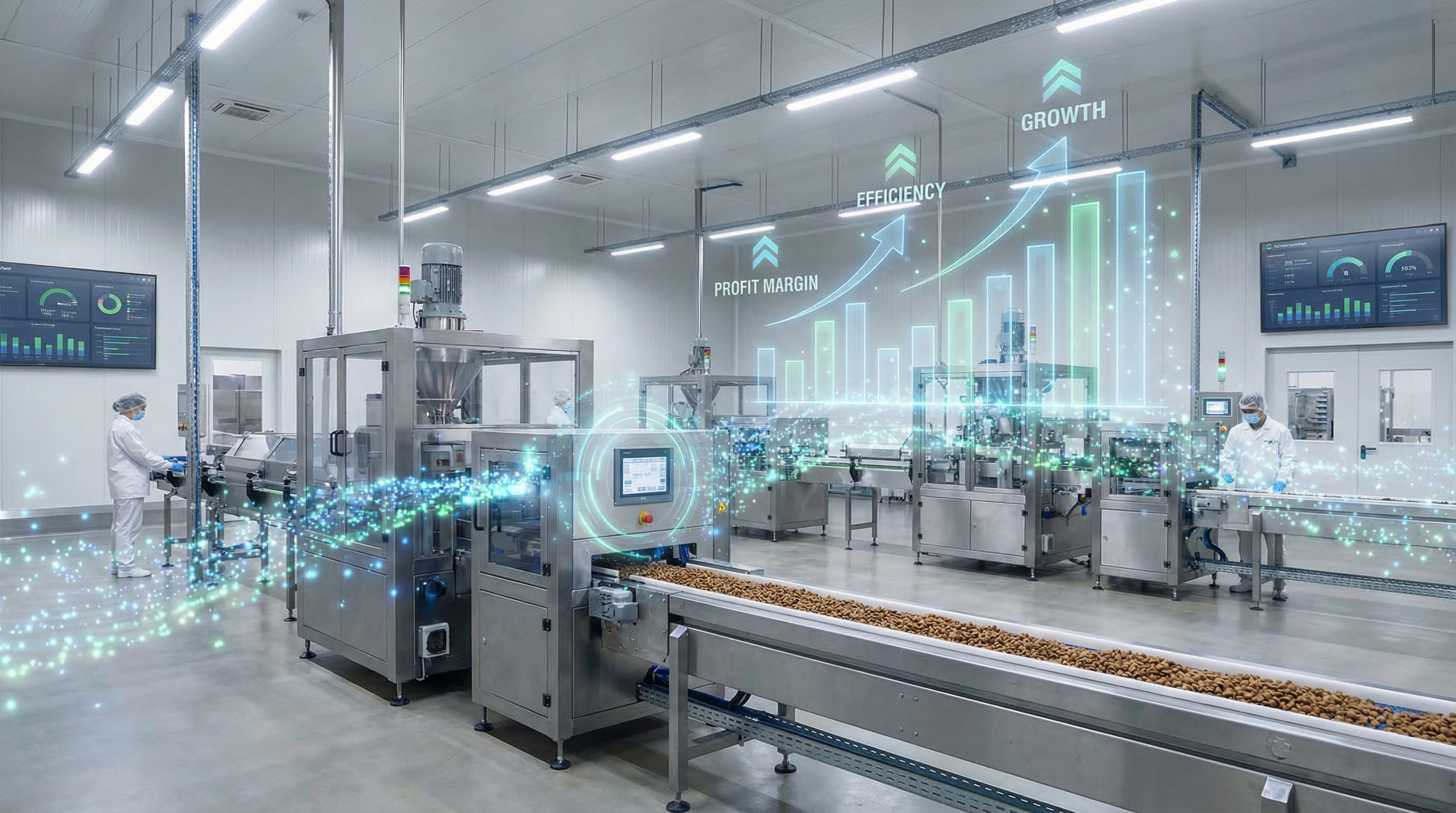
Organizations integrating AI across formulation, compliance, digital shelf management, and market intelligence are not doing so because the technology is novel. They are doing it because the economics are impossible to ignore. Faster formulation cycles translate to faster product launches. Automated compliance reduces delays and lowers regulatory risk. Real-time digital shelf intelligence improves revenue execution. Continuous market intelligence leads to stronger and smarter strategic decisions.
None of these capabilities requires a wholesale transformation of existing operations. The most effective implementations begin with a specific, high-value problem — a formulation bottleneck, a compliance backlog, or a digital shelf visibility gap, and build from there. The technology available today is designed to work alongside experienced teams, not replace them.
For leaders who have spent years building operational excellence in pet food manufacturing, the opportunity is not to start over. It is to layer AI capabilities onto the institutional knowledge and category expertise your organization already possesses, accelerating the outcomes you have always been driving toward.
The Petfood Forum in Kansas City on April 28–29 will bring together the industry's leading voices on these and other emerging technologies. Cambridge PetTech will be present at Booth #2836 and welcomes attendees who want to explore how these capabilities are being applied in practice.