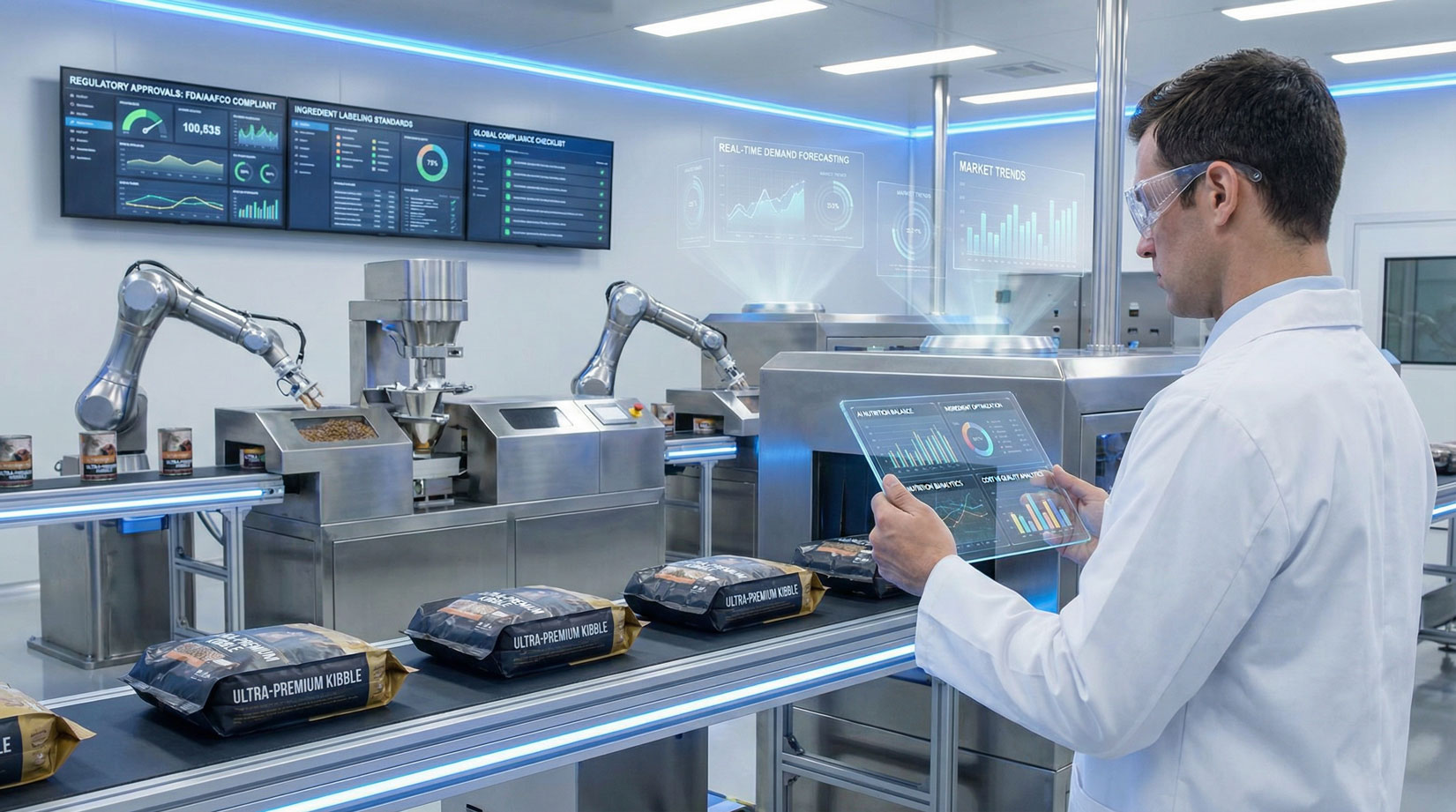


Across the rapidly expanding animal health market, an interesting yet clear operational divide is emerging. On one side are enterprises with a heavy reliance on intuition for decision-making and manual processes, who are starting to lose relevance. On the other hand, enterprises that invested early in building data-driven cultures are shortening their timelines for time-to-market, deepening client relationships, and ultimately capturing more market share. This operational divide is even more poignant as the global animal health market size, which was valued at USD 62.89 billion in 2024, is projected to reach USD 112.33 billion by 2030, growing at a CAGR of 10.46% from 2025 to 2030.
McKinsey research highlights that enterprises that build and harness data-driven cultures are 23 times more likely to acquire new consumers, 6 times more likely to retain them, and 19 times more likely to be profitable. However, organizations in the pet and animal health industry spectrum are yet to fully make this transition. The strategic question shouldn’t be whether to build a solid data culture or not —it is how swiftly organizations can operationalize data as a competitive asset before their market position erodes.
This blog examines how retailers and manufacturers are transitioning from intuition-based decision-making to systematic, data-driven strategies—and the measurable impact this has on their businesses.
The Current State: Two Verticals, One Challenge
Retailers Face the Inventory Efficiency Gap
Pet retailers dealing with thousands of SKUs across multiple locations are caught in a bit of a bind. While there's a surge in consumer demand, operational limitations are making it hard to see any profit growth. The reliance on manual purchasing, the scattered inventory visibility between stores and online sales, and a tendency to react to problems rather than proactively manage them — add layers of complexity. Instead of focusing on strategic vendor relationships and optimizing product assortments, valuable time gets wasted on daily crises.
The impact is significant: stockouts can lead to lost sales, overstocking can tie up funds, and distribution inefficiencies can really hurt profit margins.
Industry Use case 1
How a Norwegian Retailer Built a Data-Driven Inventory Culture
For specialized retailers like this Norwegian company, managing 10,000 SKUs across 15 stores and two online platforms presented some significant operational challenges. They pinpointed that manual replenishment and inadequate reporting were significant bottlenecks stifling their growth. To tackle this, the organization rolled out a comprehensive end-to-end supply chain platform that included AI-powered demand forecasting, automated replenishment, and smart inventory optimization algorithms. Notably, they successfully transitioned from manual order management to automation in just two weeks after launching. The results significantly enhanced their competitive standing.
- Product availability saw a boost of 1.37 percentage points, which not only enhanced customer satisfaction but also helped cut down on lost sales.
- Even more noteworthy, inventory turnover surged by 21%—from 5.93 to 7.18—indicating a much smarter deployment of capital.
- The organization also managed to reduce the value of inventory in distribution centres by 23%, freeing up working capital while maintaining high service levels.
This shift from reactive firefighting to strategic planning represents the fundamental change that data culture enables.
Global Manufacturers Face Forecast Accuracy Challenges
Pet Nutrition and Animal Health manufacturers find themselves navigating a complicated landscape. They juggle multi-channel distribution, shifting demand signals, and a wide array of products, spanning multiple customer segments and SKU variations. Unfortunately, the old-school forecasting methods—mostly based on spreadsheets and manual processes—struggle to handle this complexity. The outcome? Inaccurate forecasts that slow down supply chain responses, lead to inefficiencies, and hinder quick adaptations to market shifts.
Industry Use case 2
How a Multinational Pet Nutrition Company Transformed Demand Planning
A large multinational pet nutrition company was facing a tough challenge: their Excel-based forecasting system was struggling to keep up with the complexity of their needs, resulting in slow responses. They struggled to keep track of forecast quality across a vast array of SKUs and found it challenging to scale their planning efforts across different teams. The manual processes in place were a barrier to the agility they needed to react to market dynamics and shifts in categories.
The solution came in the form of an AI-powered demand anticipation engine that adeptly models nonlinear relationships and demand variability. This innovative approach enabled the company to automate demand forecasting for about 60% of their product portfolio, allowing human planners to dedicate their efforts to the more critical cases that required strategic focus. By leveraging machine learning algorithms, they were able to factor in sales velocity, market events, and category changes into their predictive models.
- The impact was game-changing, with an impressive 70% improvement in forecast accuracy across vital distribution channels.
- What’s even more significant is that 42% of volume-driven decisions are now made through automated baseline planning, which lets planners focus on exceptions and strategic priorities.
- The organization has gained agility in forecasting and enhanced scenario modeling capabilities, enabling proactive decision-making in the supply chain.
This transformation highlights an important point: a strong data culture doesn’t replace human expertise; instead, it enhances it by handling routine decisions and allowing human judgment to focus on more valuable strategic challenges.
Beyond These Cases: The Broader Data Culture Imperative
While these two case studies illustrate the power of data adoption in specific use cases, the strategic opportunity extends far beyond individual operational improvements. Organizations building comprehensive data cultures achieve compounding competitive advantages.
For Retailers: Beyond Inventory Optimization
Data-driven retailers are deploying advanced analytics across the entire business ecosystem:
- Customer insights and personalization: By diving into purchase behavior, demographics, and channel preferences, businesses can create marketing strategies that feel tailor-made for each customer. This approach not only boosts customer loyalty but also helps in maximizing their lifetime value while keeping churn rates low.
- Demand forecasting at scale: Retailers can leverage predictive models that factor in seasonality, market trends, and external influences to forecast demand effectively. This capability helps them avoid stockouts and fine-tune pricing strategies in real-time.
- Vendor performance optimization: By conducting data-driven evaluations of suppliers—looking at delivery times, order accuracy, quality metrics, and cost efficiency—businesses can make more informed partnership decisions and negotiate better outcomes.
- Data-driven retailers achieve 15-25% improvement in inventory turns while reducing markdown rates by 10-15%.
For Manufacturers: Innovation and Supply Chain Agility
Manufacturers building data cultures achieve transformational results across research, development, and distribution:
- Accelerated product development: The world of product development is being transformed with AI. With AI-driven product formulation testing, R&D cycles have shifted from traditional lengthy timelines to much quicker schedules.
- Ingredient optimization and market trend analysis are enabling quicker innovation cycles.
- Regulatory automation: When it comes to regulatory automation, the generation of FDA documents, which used to take forever, can now be largely automated with smart data systems, trimming compliance timelines by weeks.
- Market responsiveness: By analyzing huge volumes of customer feedback and market signals in real-time, manufacturers can spot trends sooner, tweak their product strategies more swiftly, and seize emerging demand.
The Framework: How Organizations Build Data Culture
Organizations that have successfully built data-driven cultures share a common implementation pattern—one that de-risks transformation and builds confidence through early wins.
Crawl: Prove Data Value in a Single Use Case (4-8 Weeks)
In this initial phase, always begin with one operational pain point. Many retailers might choose to begin with demand forecasting for their top 20 SKUs. Manufacturers might want to focus on driving forecast accuracy for a single product line.
This phase requires minimal investment from the enterprise, often just pilot licensing and support for implementation. The conclusion however is critical: concrete proof that data-driven approach cycles deliver measurable value in the enterprise's tailored context. Success in this Crawl phase will boost organizational confidence and help build a clear roadmap based on data-backed results.
Walk: Scale Across the Enterprise (3-6 Months)
Once value is proven in a single use case, organizations expand systematically. Systematic expansion could be begun for organizations once a single use case delivers the desired result. Retailers can move towards deploying forecasting and optimization across several product categories and locations. Manufacturers can now begin to automate demand planning across their broader LOBs.
The Walk phase helps in building organizational capability and demonstrates ROI. Teams start to become comfortable with technology. Stakeholders and Clients start to identify benefits firsthand. Leadership gauges through clear business metrics, justifying further investment.
Run: Enterprise-Wide Data Transformation (6-18 Months)
Only after a certain essential value has been proven across smaller deployments, should organizations commit to comprehensive Run phase. At this juncture, data culture becomes embedded across decision-making processes, synonymous with most functions. Retailers deploy fully integrated platforms with predictive capabilities across all business functions. Manufacturers implement AI-driven planning across the full product portfolio with scenario modeling.
The Bottom Line: From Reactive to Strategic
Adopting new technology comprises only a small part of building a data culture. It is about intrinsically shifting how enterprises make decisions—from intuition and historical patterns and intuition to predictive analytics and empirical evidence. The enterprises profiled across the two industry use cases in this article did not transpire their digital transformation overnight. They started with a single problem statement, proved value through data-driven solutions, and then scaled from there.
The competitive gap is real and widening. Organizations investing in data culture today are:
- Retailers achieving higher inventory turns, better customer satisfaction, and lower capital tied up in excess stock
- Manufacturers accelerating innovation cycles, improving forecast accuracy, and responding to market changes faster
The question is not whether to build a data culture. The question is whether your organization will lead this transition or react to competitive pressure as others move ahead.
At Cambridge PetTech, our 25+ years of enterprise data and AI expertise has been almost exclusively focused on the pet and animal health industry, bringing this multidisciplinary understanding. Proven methodologies—like the crawl-walk-run approach—minimize disruption while accelerating value realization.
Next Steps: Start Your Data Culture Transformation
Irrespective of whether you’re from the retail or manufacturing vertical, the goal remains the same. Start with something small, verify the definitive value, and then scale from there. Enterprises that are willing and ready to take that step must first identify an operational pain point where a data-driven solution could deliver a cognizable impact.
Schedule Your Strategy Consultation
Let's discuss your specific operational challenges and identify the right starting point for your data transformation. Cambridge PetTech experts will help you understand realistic timelines, required resources, and expected ROI—with no obligation.
Contact Us | Email: sales@cambridgepettech.com