

Your digital shelf report says "96.7% accurate." Then someone asks how many checks failed to run. The answer: one in ten.
In this illustrative audit, 900 of 1,000 planned attribute checks were verified, with 30 material discrepancies. The reassuring headline describes only the checked portion. The other 100 remain unknown.
For pet food teams, a useful report must show both what is wrong and what has not been established.
What is the Product Truth Gap?
The Product Truth Gap is our working framework for material differences between approved product information and its published representation. Material differences can affect identity, suitability, use, claim interpretation, or a purchase decision.
Measure confirmed discrepancies, affected listings, severity, and verification coverage separately. A wrong species and a missing qualification do not share a meaningful numerical "distance." The framework is an operating method, not a regulatory standard or certification.
What belongs in the denominator?
Define planned, applicable checks before collecting results. Failed checks stay visible against that scope.
One check should identify an attribute, product variant, retailer listing, and observation window. Include seller, location, or purchase conditions when relevant. A 15 lb bag and a multipack need distinguishable records.
Build the scope from actual distribution. Multiplying every product by every retailer overstates coverage if some products are not carried there. Document exclusions and distinguish a confirmed absent listing from an inaccessible page. A capture establishes what the monitoring session observed under recorded conditions, not what every shopper saw.
How should coverage and discrepancies be reported?
Report verified checks as a share of planned checks, and confirmed material discrepancies as a share of verified checks. Identify pending assessments separately.
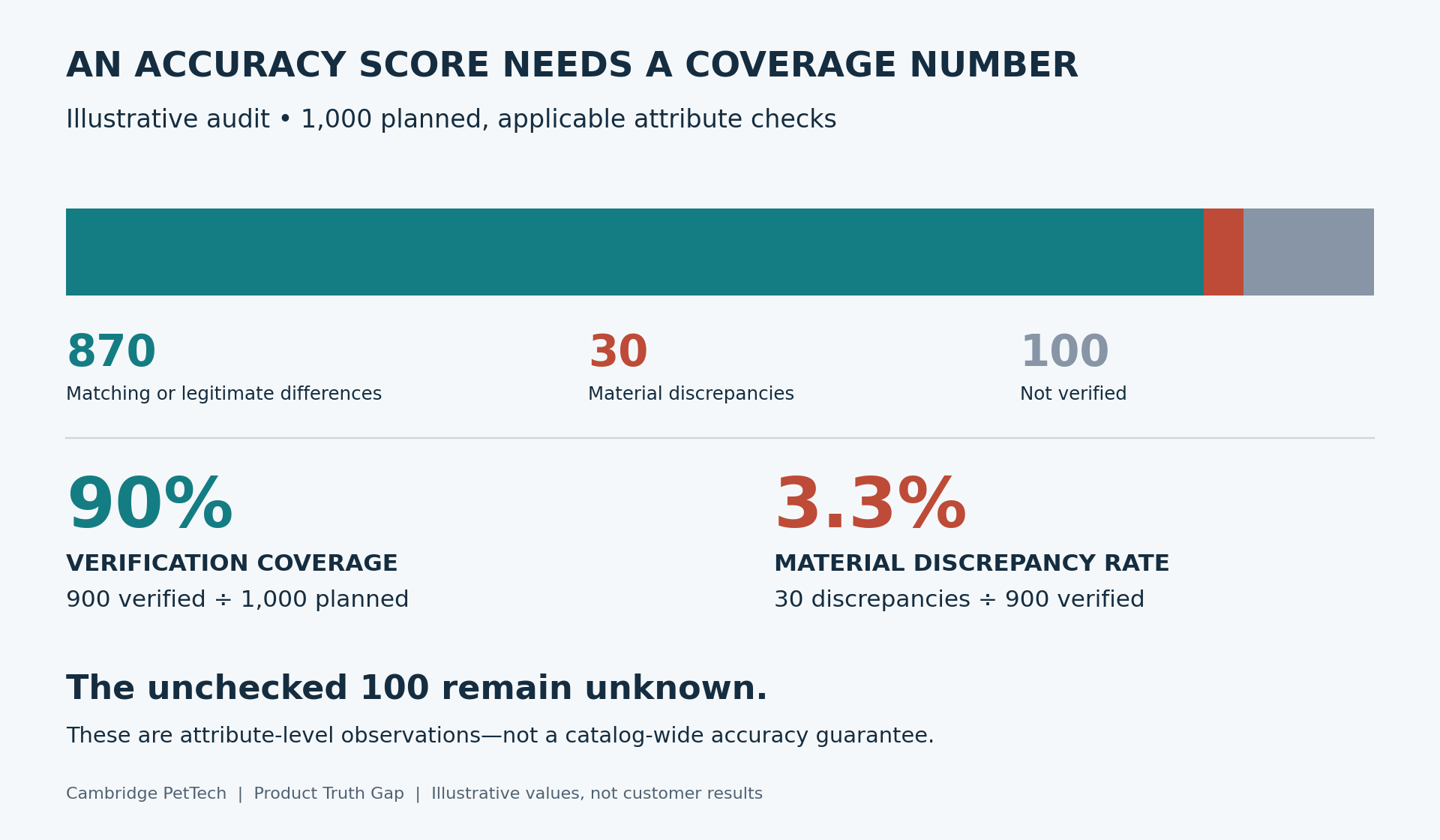
I
llustrative attribute-level audit; no pending assessments in this example.
Here, 870 checks match or have documented legitimate differences; 30 have confirmed material discrepancies. All 900 are assessed. Coverage is 90%, and the material-discrepancy rate among verified checks is 3.3%. Neither figure establishes whole-catalog accuracy.
Retain five outcomes: matching, legitimate difference, confirmed material discrepancy, pending assessment, and not verified. An unresolved reference conflict belongs in pending assessment; failed access or unreliable extraction belongs in not verified. Neither counts as a pass. Show affected-listing counts separately from attribute counts.
Keep the scope stable when comparing periods, or disclose changes. An improved percentage may reflect removal of difficult listings rather than corrected content.
Is every difference an error?
No. Compare the applicable product version and preserve legitimate offer differences.
An older image may correctly represent inventory during a packaging transition. Different sellers may legitimately have different prices or stock. These require context, not automatic correction to the newest brand-page value.
For product facts, the brand or parent website supplies the retailer-comparison baseline. Validate that baseline against current approvals. Where upstream sources conflict, resolve the affected attribute; continue checks with reliable references. Record legitimate exceptions with a rationale, owner, and review date. Accepting an unresolved risk does not make inaccurate content correct.
Google documents website/feed update lag for price and availability.[1] That supports checking synchronization; it does not establish why a particular retailer's ingredient statement differs.
Which discrepancies deserve attention first?
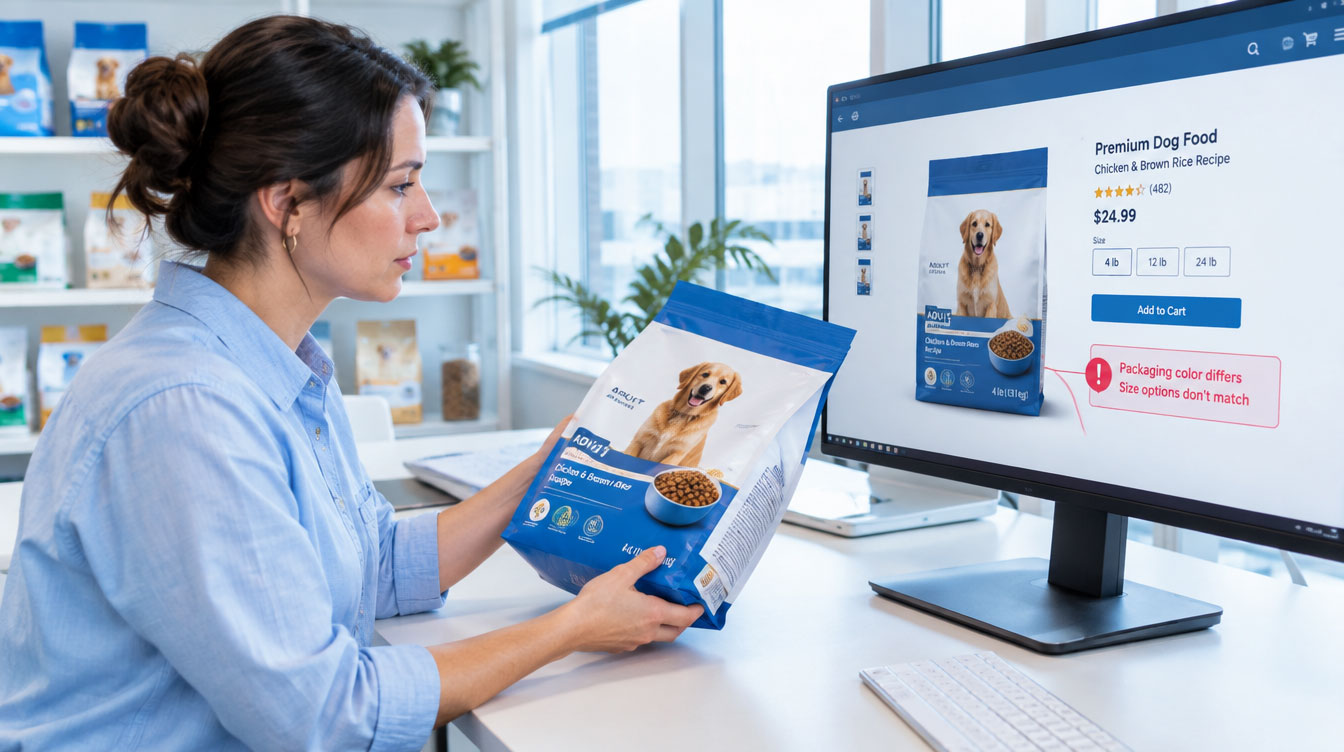
Prioritize the consequence of the specific discrepancy, not its category alone. A wrong-pack image may misidentify the product; a missing claim qualification may broaden its apparent benefit.
Ingredient statements, nutritional adequacy, and feeding directions need checks that preserve meaning. FDA explains ingredient ordering and federal labeling requirements; AAFCO describes model provisions and state authority.[2] [3] These inform review without making every field mismatch a legal violation.
Upstream changes matter too. FormuLogic's formulation scenario analysis supports evaluation of ingredient and nutrient trade-offs. Once a formulation change is approved, review whether published information needs updating. Package InteliX's packaging and claims review supports that upstream assessment. A formulation output should not automatically become approved label copy.
Do you need to inspect every listing?
Use full-scope observation for an actionable issue inventory; use sampling for explicitly bounded estimates or quality checks.
A sample cannot identify every affected listing. A full automated scan still depends on correct matching and extraction. Human review of selected results can test whether apparent matches and flags are trustworthy.
ShelfAnalytiX digital shelf monitoring compares brand or parent-website listings with listings across 10+ retailers, including Amazon, Chewy, Petco, and PetSmart, and flags content, image, pricing, and availability discrepancies for review. Define the configured coverage and unresolved checks alongside the findings.
How do you verify correction and commercial relevance?
Recheck the published presentation, preserve the evidence, and keep content findings separate from claims about sales impact.
Record elapsed time from confirmed detection to the first verified corrected observation. Unless publication records establish otherwise, that is not the retailer's exact implementation time. Two snapshots cannot prove whether a correction happened and later reverted.
Monitor recurring consumer concerns alongside listing evidence. BrandEQ's consumer-feedback analysis can surface themes across reviews and social channels that help teams prioritize investigation. A complaint about packaging is a signal to examine; it does not prove a listing error or its cause. These product roles are complementary, not a claim of automatic integration.
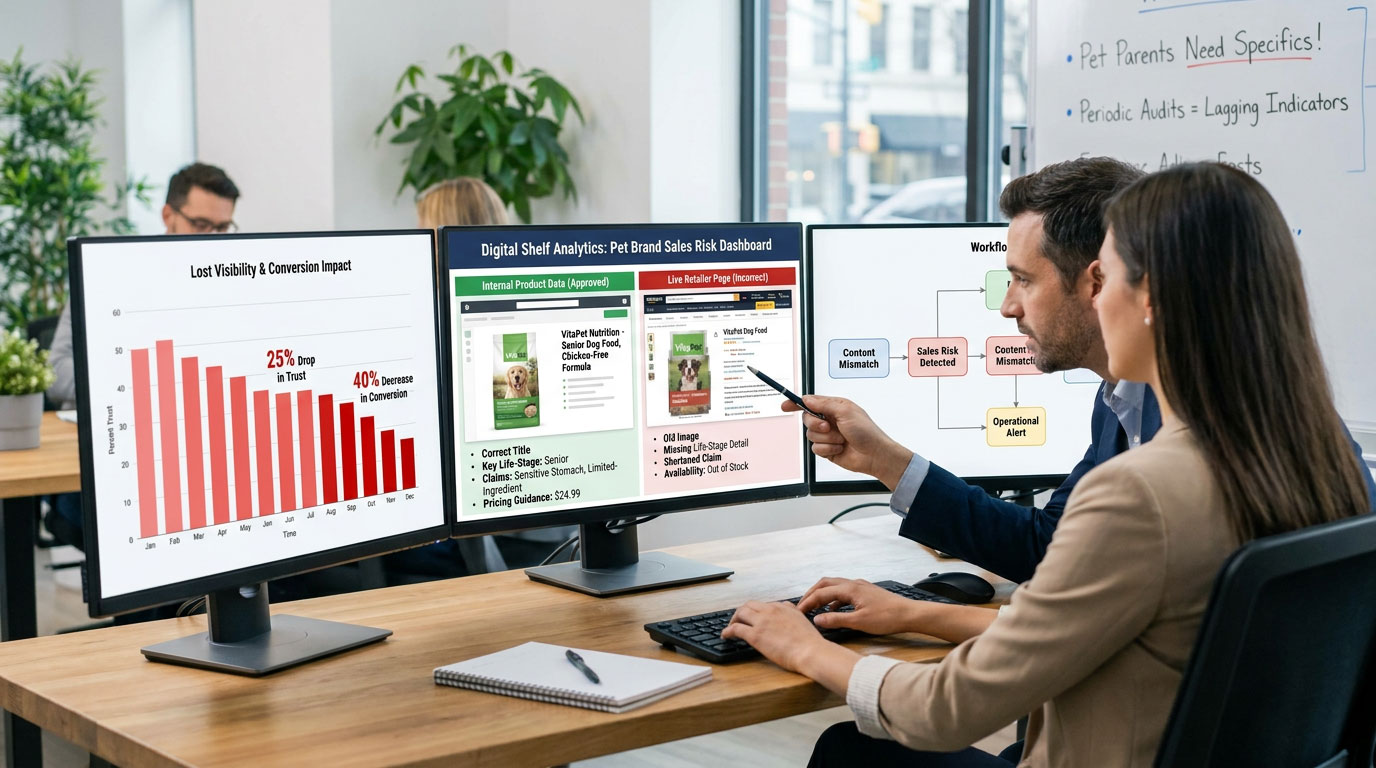
Our discussions of digital shelf analytics and retailer sales risk and packaging compliance reviews cover the commercial and upstream context.
Start with one priority range. Fix its scope, references, and status rules; then report coverage, unresolved material discrepancies, and verified corrections. That gives leadership a number it can question—and a list the team can act on.
Sources and notes
Primary sources checked September 10, 2026. Audit figures are illustrative; proposed measures are not benchmarks. Retailer coverage is company-provided. Product links describe separate roles, not promised integrations.