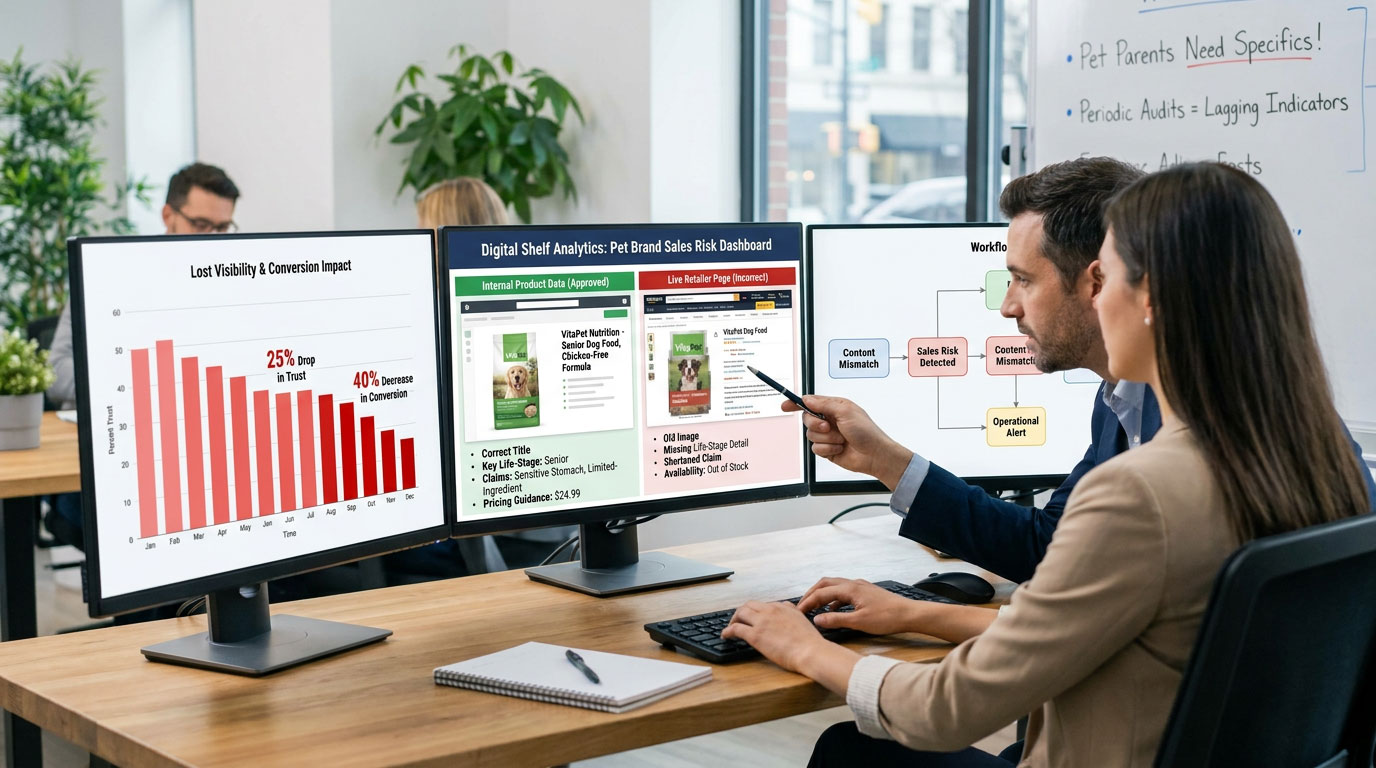

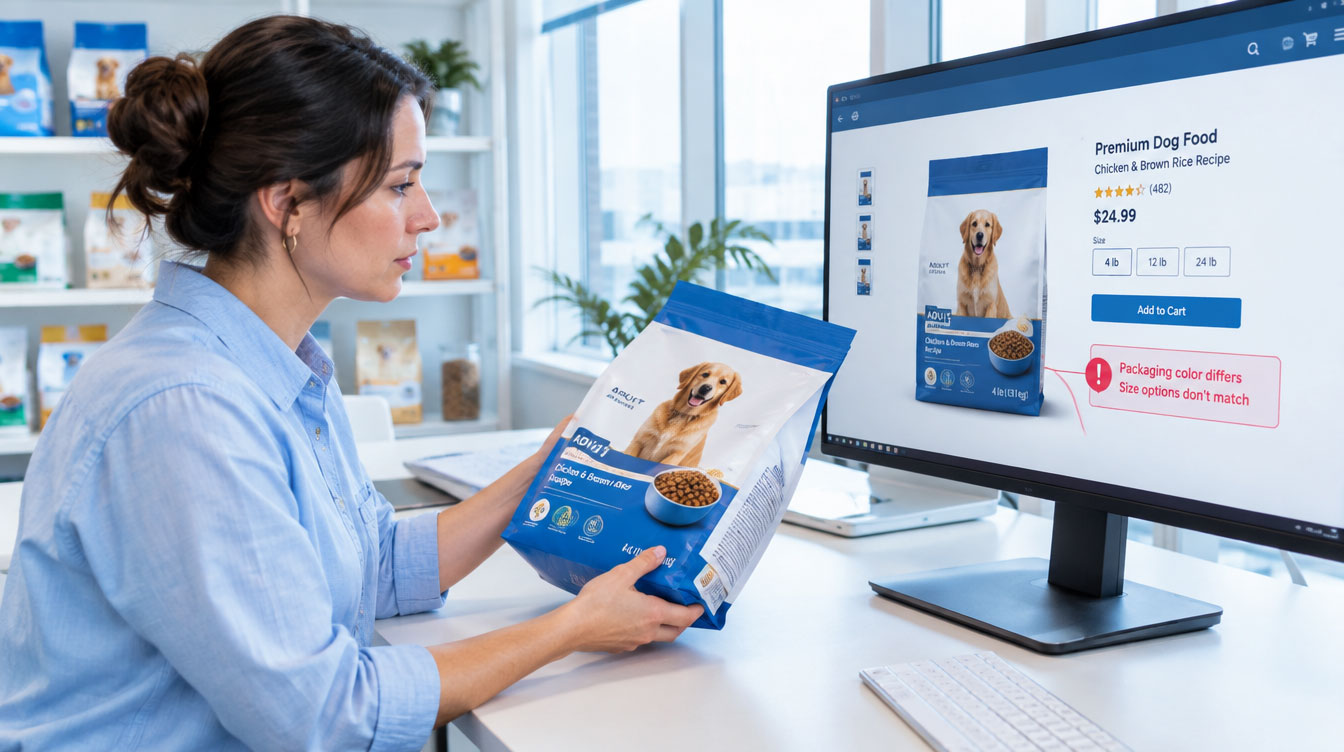
A brand replaces a 20 lb dog-food bag with an 18 lb pack. One retailer sells the replacement under a title promising 20 lb. Another still sells correctly described 20 lb inventory.
Both differ from the brand's newest product page. They should not receive the same correction.
This illustrative transition shows why packaging change control needs a digital completion record. Teams must establish which product an offer represents, what content applies, and whether the published page accurately describes it.
When does a packaging change require a new GTIN?
A change to declared net content requires a new Global Trade Item Number under GS1 rules. The 20 lb-to-18 lb replacement therefore needs a new identifier, with affected higher packaging levels addressed too.[1]
Other changes require assessment against their relevant rules. GS1's formulation/functionality rule combines an effect on legally required packaging information with an expectation that consumers or trading partners distinguish the change.[1] Artwork revision alone does not settle the decision.
Record the assessed rule, decision, and relationship between predecessor and replacement. GS1 identification standards and pet food labeling law are separate requirements.
Can an unchanged GTIN hide outdated content?
Only if the checking process relies on identifier changes instead of comparing affected attributes. A GTIN helps identify an item; it does not confirm that the image or description is current.
Keep previous approved content, replacement approved content, and observed retailer content as distinct records. The observation may contain errors; it cannot serve as evidence that an older version was approved.
A replacement image beside an old ingredient statement may be a partial update. Assess the page against the applicable version, rather than accepting any value found somewhere in the archive.
Does an old pack image always need replacing?
No. It may accurately represent legitimate inventory still being sold. Establish the offer and stock context before requesting a change.
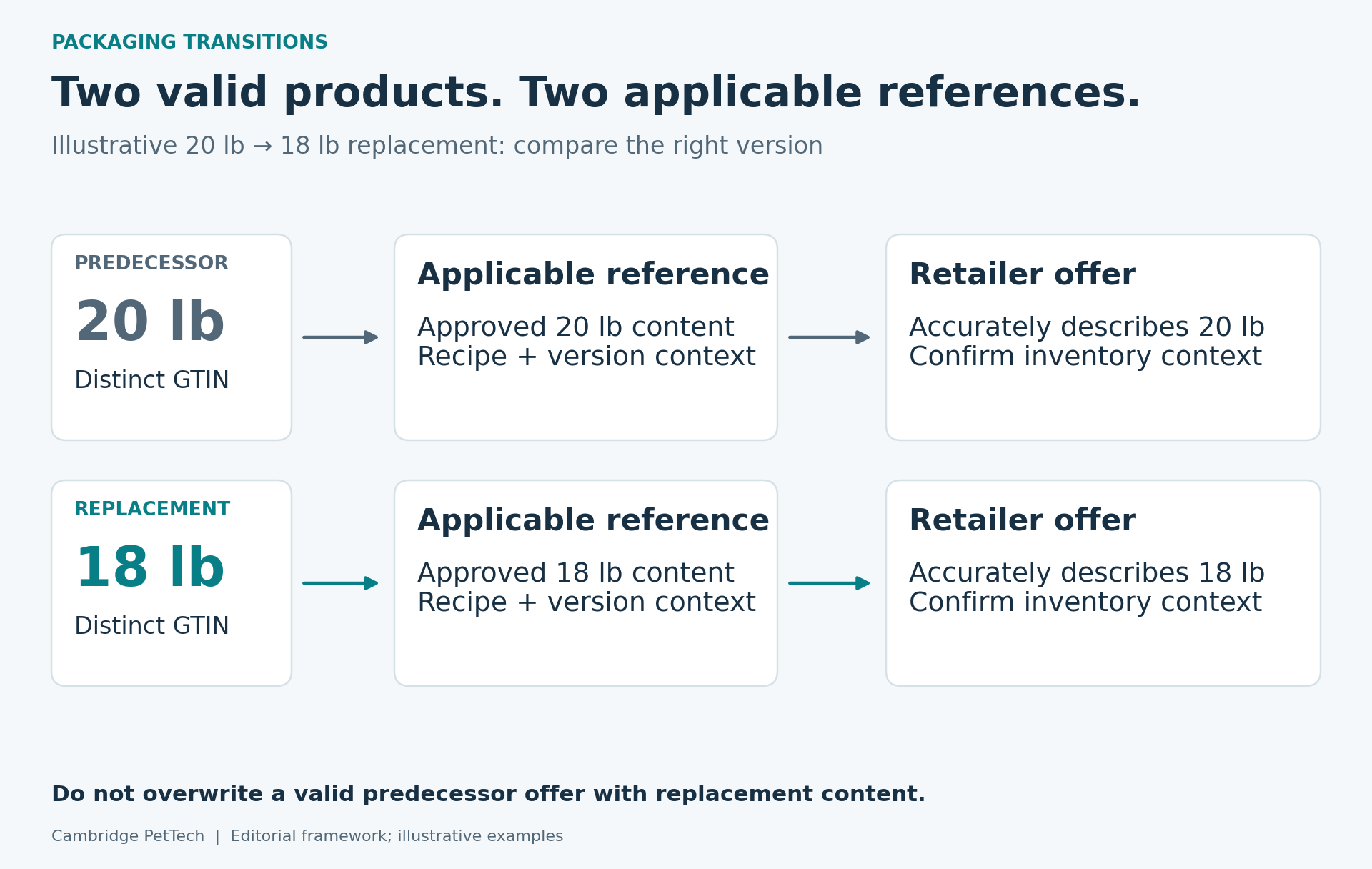
Original infographic: An illustrative framework, not measured customer results.
In the example, the predecessor listing needs to represent 20 lb while the replacement listing represents 18 lb. If the retailer cannot establish which pack will ship, the uncertainty needs resolution through the account relationship. A screenshot cannot establish physical inventory.
For artwork changes under the same GTIN, document permitted overlap, affected attributes, and review conditions. Retiring a product internally does not prove retailer sell-through. A general "packaging may vary" statement also requires assessment against the actual difference; it should not become permission to misstate quantity or suitability.
What does Pet Food Label Modernization add?
PFLM creates information and data-mapping work alongside artwork changes. AAFCO's model revisions cover nutrition presentation, intended use, ingredient terminology, and optional handling/storage information.[3]
AAFCO's enforcement-discretion recommendation uses six years from availability of the printed 2024 Official Publication and provides for annual review. State adoption and enforcement determine applicable requirements; the recommendation is not a nationwide deadline calculated from the 2023 vote.[2]
The recommendation explicitly recognizes analytical and software work, including dietary-fiber data and eCommerce platforms.[2] Teams should review field definitions and units rather than treating modernization as an image swap. Establish the applicable requirements before choosing a transition schedule.
Who owns the retailer update?
Assign one change owner accountability for the completion record, with named responsibilities across functions. This is an operating recommendation, not an allocation of legal liability.
Start upstream if the packaging change follows reformulation. FormuLogic's formulation scenario analysis supports comparison of ingredient, nutrition, and cost trade-offs. Once a change is approved, identify which declarations and claims need review.
Package InteliX's artwork and compliance review supports source comparison and approval history. The resulting approved version must then reach the brand website and retailer submissions. Our discussion of packaging compliance reviews develops that upstream discipline.
How do you verify the change reached retailers?
Inspect the affected listing components against the version applicable to that offer, then recheck any correction. Submission acknowledgment is not completion.
ShelfAnalytiX digital shelf monitoring supports comparison of brand or parent-website listings with retailer content and images. Configure the affected products and attributes; retain transition context when assessing differences.
Record the selected variant, seller, URL, capture time, expected version, observed content, owner, and disposition. Mark inaccessible or poorly extracted components as unverified. Set check timing around expected publication and the consequence of the change.
Consumer reports can expose a different problem. BrandEQ's consumer-feedback analysis can surface packaging or quantity concerns for investigation. Compare those reports with listing and fulfillment evidence before assigning a cause.
When is a packaging change digitally complete?
When every in-scope listing has a verified applicable representation, including any documented legitimate transition variation. Keep unresolved inaccuracies and unverified observations open; accepting risk does not establish correctness.
Report coverage, unresolved material differences, and exceptions due for review. Completion applies to the recorded scope and observation time, so continue checking for recurrence. This connects Digital Shelf Surveillance with Continuous Digital Compliance.
Where controlled, verify feeds separately: Google documents lag between website and feed updates.[4] Preserving the correct variant in these outputs also supports AI product discovery.
For the next packaging release, ask the change owner for the retailer completion record alongside the approved artwork. Both are needed to show where the transition stands.
Sources and notes
Primary sources checked September 10, 2026. Examples and workflows are illustrative. U.S. regulatory context. Product links describe capabilities, not automatic integrations or compliance guarantees.