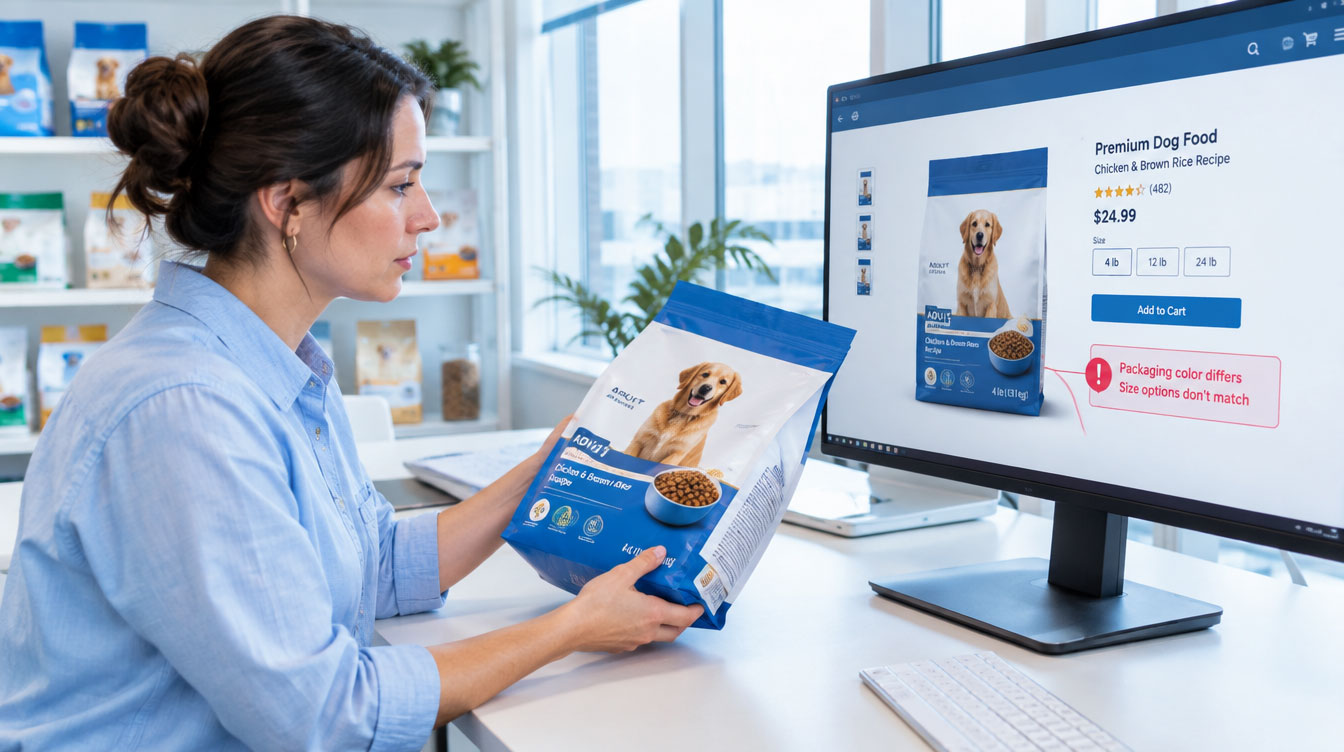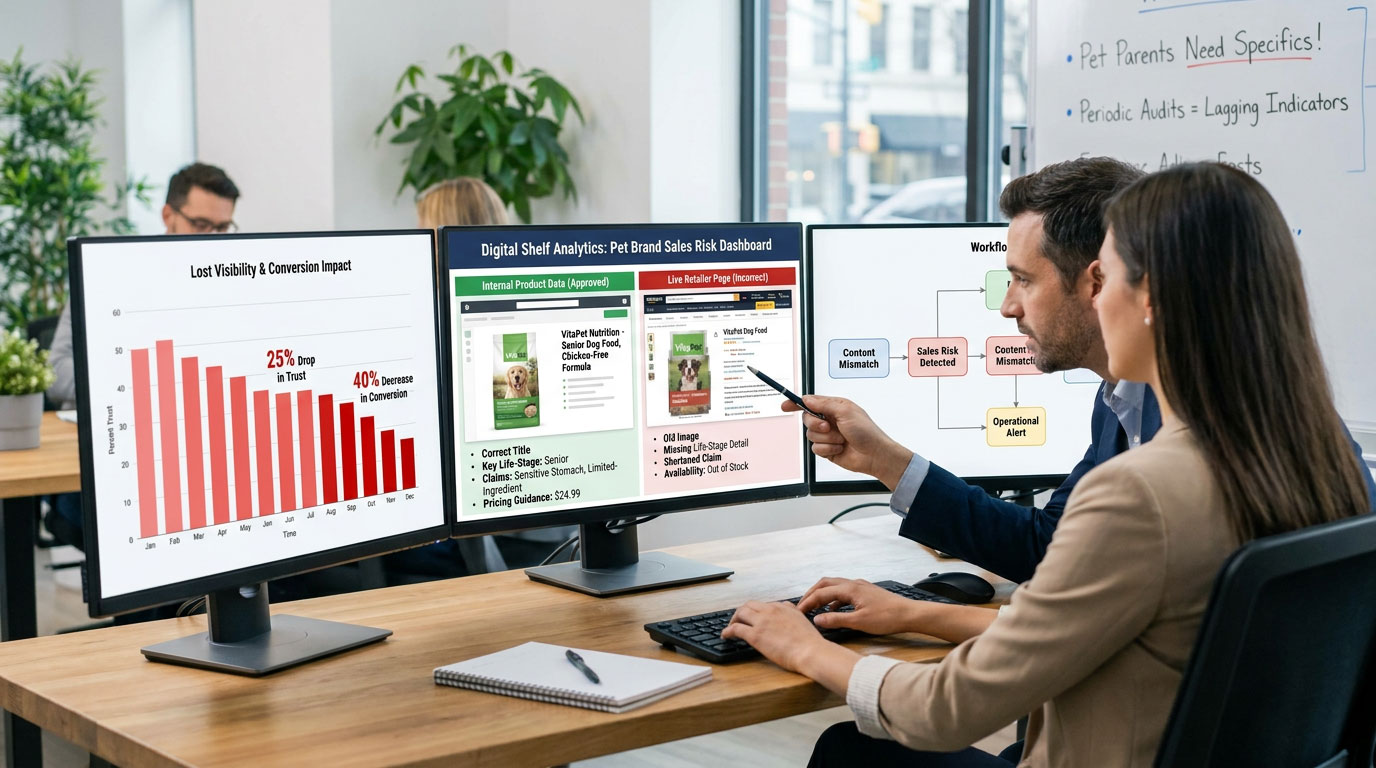


An adult-maintenance dog food has approved packaging and an accurate brand website. On a retailer page, the title says adult, the image shows puppy food, and the nutritional details describe another recipe.
This illustrative scenario poses a question packaging sign-off cannot answer: Which product does the shopper believe they are buying?
Pet food compliance needs a check on the published presentation. The task is to establish the right reference, detect meaningful differences, and verify that corrections reach the live page.
What is the Product Truth Gap?
The Product Truth Gap is our term for material differences between approved product information and its digital representation. A shortened title may preserve meaning. Changing adult maintenance to all life stages does not.
The brand or parent website supplies the retailer-comparison baseline, but must itself reflect current approvals. Aligning every retailer with an incorrect brand-page value would spread the error.
Tie the reference to recipe, species, pack size, market, and approved version. If sources conflict, hold the affected attribute for assessment. An older image may correctly represent remaining inventory during a packaging transition.
Can online pet food claims create regulatory risk?
Yes. Online communications can raise labeling or advertising concerns even when the physical package has been reviewed. Their legal significance depends on the content and circumstances.
FDA explains that labeling extends beyond the container to accompanying material. Disease-related representations can indicate an intended animal-drug use.[1] AAFCO develops model provisions; state authorities adopt and enforce their requirements. AAFCO does not approve individual products.[2]
FTC guidance considers the overall advertising impression, including implied claims.[3] A matching sentence can therefore need review when a headline or image changes its apparent meaning. A monitoring alert is an assessment trigger, not a determination of a violation.
Which content differences deserve attention first?
Prioritize consequences for product identity, suitability, instructions, and claim meaning. Read titles, images, bullets, and selected variants together.
Illustrative checks for product content accuracy
A qualification buried in a packaging image may not resolve a misleading headline. FTC's digital-disclosure guidance emphasizes noticeable presentation close to the relevant claim.[4]
What does Continuous Digital Compliance require?
It requires a repeatable cycle of observation, assessment, correction, and verification. Digital Shelf Surveillance is our term for the observation activity within that cycle. Neither term denotes certification.
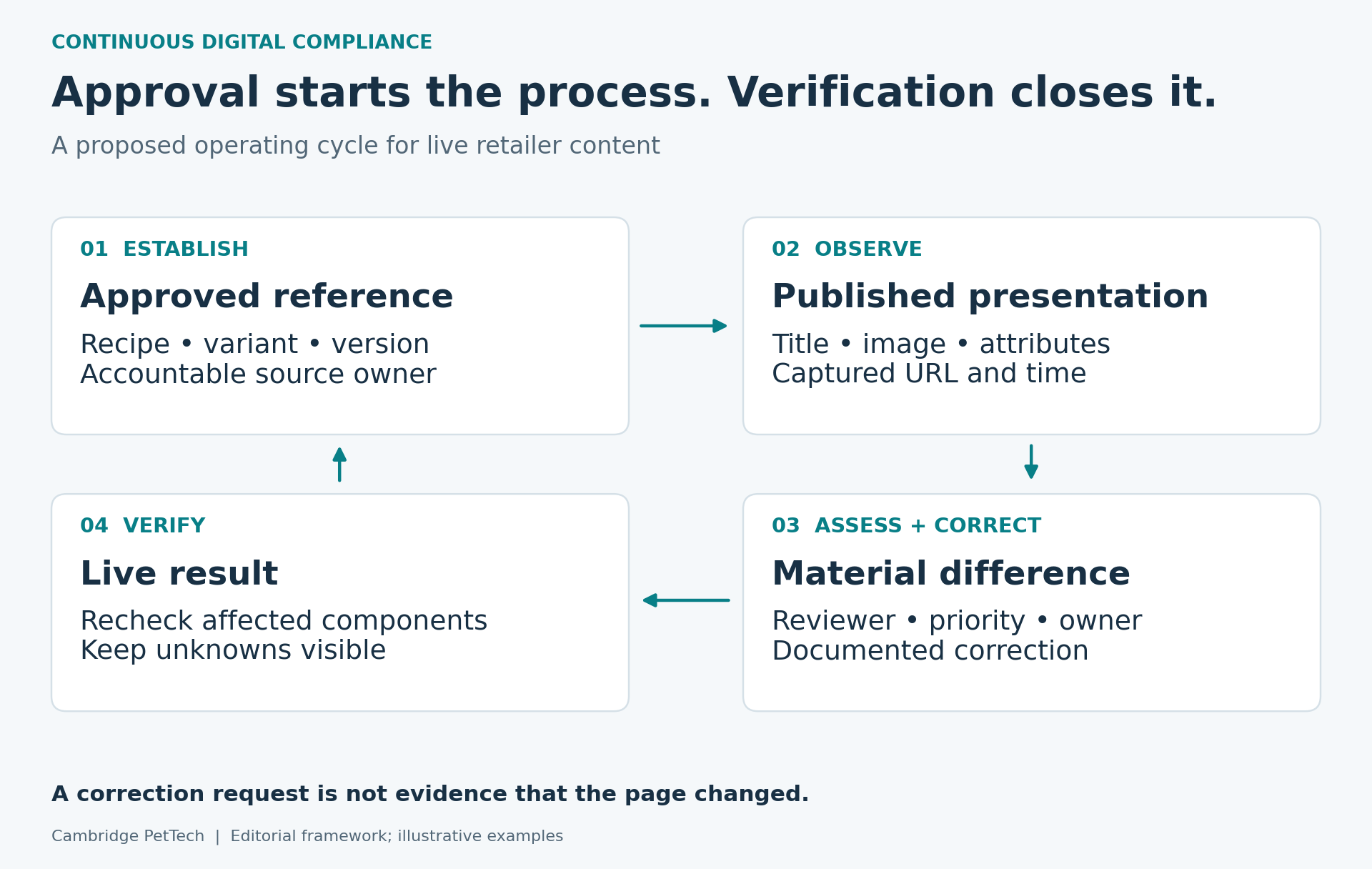
Original infographic: An illustrative framework, not measured customer results.
Define the intended product-retailer combinations, attributes, and check frequency before collecting results. Match the product and variant before comparing values. Preserve units, ingredient order, and qualifiers; exact-number matching alone is insufficient.
For each actionable finding, retain the URL, seller, selected variant, capture time, original evidence, reference version, and reason for the flag. Record failed access or unreliable extraction as unverified. Uncertainty must not become a pass.
Regulatory or QA assesses sensitive discrepancies. eCommerce coordinates content corrections; account teams escalate with retailers. Recheck the relevant page components before recording a verified correction. A submission receipt only confirms the request was sent.
Are pricing and availability alerts labeling violations?
They require separate commercial assessment. A retailer's stock position or selling price need not match the brand website.
Assess minimum advertised price (MAP) against the applicable policy and effective dates, with seller, pack quantity, promotion, and subscription conditions recorded. A brand-site selling price alone is not a MAP policy. For availability, retain location, fulfillment option, and observation time.
This separation helps commercial teams act on digital shelf analytics findings without routing every offer difference to regulatory.
How does monitoring complement packaging review and PIM?
Approval establishes the reference; product information management prepares distribution; monitoring verifies the published result. These controls answer different questions.
Package InteliX's packaging and claims review supports upstream assessment and approval history. ShelfAnalytiX digital shelf monitoring compares brand or parent-website listings with 10+ retailers, including Amazon, Chewy, Petco, and PetSmart, flagging content, image, pricing, and availability differences for review.
Consumer feedback adds another investigation input. BrandEQ's review and social-feedback analysis can surface recurring packaging or product concerns. Those signals help prioritize inspection; they do not prove a listing caused the complaint.
These are complementary product roles. The operating process still needs explicit handoffs, reviewers, and closure evidence.
What should leadership ask to see?
Ask for coverage, unresolved material discrepancies, and verified corrections for a defined product range. Report failed checks alongside results so a quiet dashboard cannot conceal missing observations.
Include separately checked feeds and structured data where the team controls them. Google documents website/feed synchronization lag.[5] A corrected page does not establish that its machine-readable output changed. Preserving identity, qualifications, and version context supports AI-Ready Product Truth.
Begin with a priority range and a dependable reference. At the next review, ask: What was approved, what was observed, and what evidence shows the correction is live?
Sources and notes
Primary sources checked September 10, 2026. Examples and workflows are illustrative. U.S. regulatory context. Product links describe capabilities, not automatic integrations or compliance guarantees.