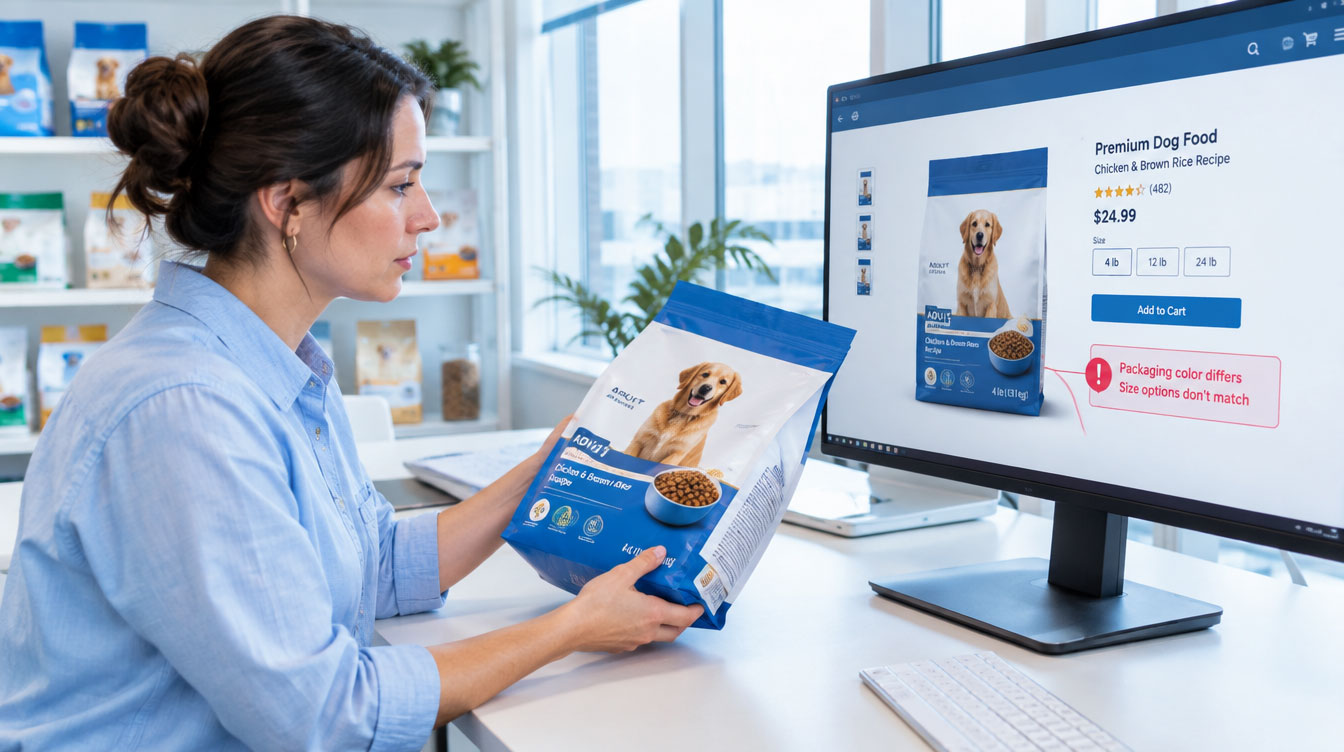


A shopper asks an AI assistant for puppy food with lamb as the first ingredient. Your brand page identifies the product for growth. A retailer classifies it as adult maintenance. Another shows the right description beneath a different recipe's image.
This is an illustrative scenario. The contradiction exists before an assistant generates an answer. The brand's first task is to resolve the published facts.
Our discussion of AI search visibility for pet food brands considers discovery. Here, the engineering question is narrower: Can a system identify the right product and preserve what its information means?
What is AI-Ready Product Truth?
AI-Ready Product Truth is our working term for product information that preserves identity, meaning, qualifications, source, and freshness when published for machine use. It is not a certification or a promise of recommendation.
A usable record distinguishes recipe, species, pack size, market, and applicable version. Its attributes remain connected to their units and limitations. The team can explain where each value came from and when it was checked.
Correctness precedes consistency. The brand or parent website is the retailer-comparison baseline, but must reflect approved information. Repeating a wrong value across every channel makes the mistake more consistent.
Which facts should agree, and which offers can differ?
Facts should agree for the same product version. Price and availability should accurately describe the particular offer.
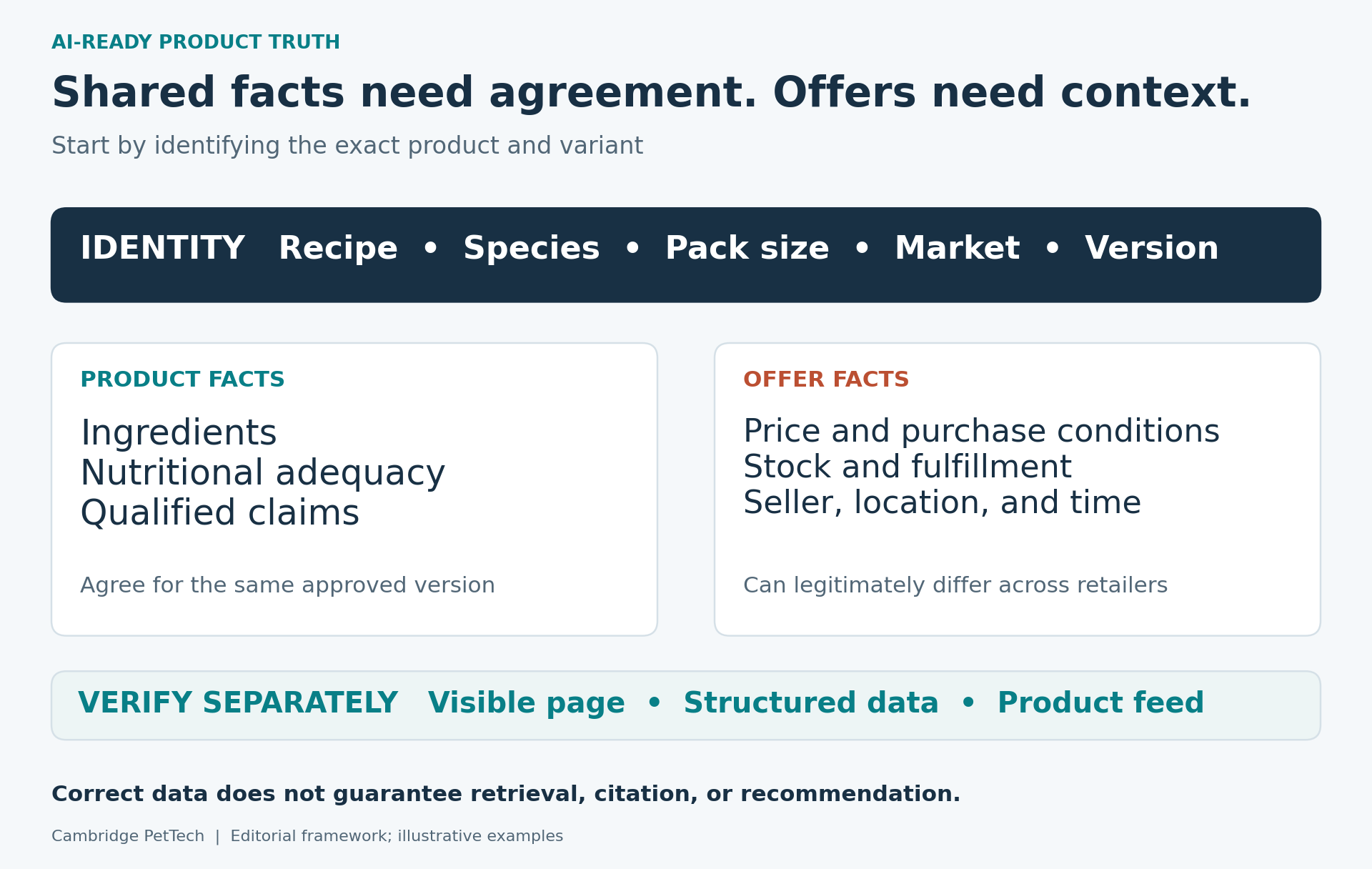
Original infographic: An illustrative framework, not measured customer results.
A 15 lb bag, a 30 lb bag, and a multipack need distinguishable records. Match the variant before comparing attributes; similar titles are insufficient.
An Amazon offer and a Chewy offer can legitimately have different prices. Subscription conditions, seller identity, fulfillment location, and observation time matter. Do not overwrite valid offer differences to manufacture consistency.
Packaging transitions need version context too. The newest brand image is not automatically the correct reference for remaining predecessor stock.
What meaning can a short product description lose?
Life-stage suitability, ingredient implications, and claim qualifications can change when content is reduced to tags.
AAFCO distinguishes complete-and-balanced food for specified life stages from food intended for intermittent or supplemental feeding.[1] A broad "life stage" field must not imply nutritional adequacy the approved statement does not establish.
Likewise, lamb as the first ingredient does not establish lamb as the only protein source. FDA describes ingredient order by predominance by weight; inspect the full statement before making a broader inference.[2]
Preserve these distinctions in the source copy and test shortened outputs. Do not infer species, suitability, or absence of an ingredient from missing data. Record the value as unknown until a reliable reference resolves it.
Do structured data and product feeds solve accuracy?
They make supported information explicit, but correct syntax does not establish correct values.
Google documents product structured data for product snippets and merchant listings, including variant relationships.[3] Its product-data guidance explains website/feed inconsistencies caused by update lag.[4]
Check each publishing output. If the page shows 15 lb and the feed says 30 lb, investigate variant mapping before changing either value. Compare the exported record, visible page, and embedded markup against the same approved item.
Platform fields may not carry every pet food qualification directly. Use supported fields correctly and preserve necessary context in the visible description. An internally useful attribute is not automatically consumed by every discovery system.
A product information management update is an upstream event. Retain export and observation records so the team can establish which downstream surfaces received it.
Can accurate data guarantee an AI recommendation?
No. It reduces avoidable ambiguity without guaranteeing retrieval, citation, or recommendation.
For supporting-link eligibility in Google AI Overviews and AI Mode, Google requires indexing and snippet eligibility. It states there are no additional technical requirements or special AI markup, and serving content remains unguaranteed.[5] Other discovery or commerce services have their own specifications.
Separate three observations: a published data conflict, an incorrect answer actually observed, and a commercial outcome. None automatically proves the cause of the next.
If testing answers, retain the query, system, date, cited sources, and output. A single result describes that observation; it is not a universal visibility score. A correct answer also does not certify the source catalog.
Where should product and regulatory teams start?
Choose a small product set that exercises different problems: a stable recipe, a packaging transition, and a qualified claim. Use it to establish references, ownership, and evidence rules before expanding coverage.
For every discrepancy, retain the identifier, attribute, expected value, reference version, observed surface, capture time, owner, and recheck result. Treat failed collection and unresolved source conflicts separately from confirmed errors.
Upstream, FormuLogic's formulation scenario planning helps teams evaluate ingredient and nutritional trade-offs. Only released, approved product information should enter the publishing baseline; a candidate formulation is not automatically label-ready.
Package InteliX's label and claims review supports assessment of source inputs, qualifications, and approval history. ShelfAnalytiX digital shelf monitoring compares brand or parent-website listings with retailer listings and flags discrepancies. Feed, markup, and AI-output audits require their own defined checks.
These roles connect formulation decisions, approved representation, and live content; they do not imply an automatic integration.
What should the readiness report show?
Show verified coverage, unresolved material conflicts, and corrections confirmed on each checked surface. "No differences found" is incomplete without the observation scope.
The Product Truth Gap identifies material disagreement. Digital Shelf Surveillance supplies repeated observations. Continuous Digital Compliance organizes review and correction of compliance-sensitive findings. AI-Ready Product Truth preserves the information's meaning for machine use.
For leaders evaluating digital shelf analytics and commercial risk, the immediate deliverable is a reconciled product record with evidence of publication. Ask what was verified and where the answer is still unknown.
Sources and notes
Primary sources checked September 10, 2026. Examples and workflows are illustrative. U.S. regulatory context. Product links describe capabilities, not automatic integrations or compliance guarantees.